
Don’t Go Broke for a Bridge
What You’re Really Paying for a Zirconia Bridge (And Whether It’s Worth It)
Zirconia bridge price is one of the most searched questions in restorative dentistry — and for good reason. The numbers vary wildly depending on who you ask.
Here’s a quick snapshot so you can orient yourself fast:
| Bridge Type | Typical Price Range | National Average |
|---|---|---|
| 3-unit zirconia bridge | $2,400 – $4,500 | ~$3,542 |
| Full arch hybrid zirconia (lab-direct) | Starting at $2,500 | Varies |
| Full arch implant-supported zirconia | $8,000 – $30,000 | Varies by case |
| Per-unit zirconia (Manhattan) | $3,000 – $5,500 | Higher in metro areas |
The wide range isn’t random. It reflects real differences in lab quality, material strength, case complexity, and where you practice.
For restorative dentists, the bigger frustration isn’t just the price — it’s paying premium rates to a high-volume milling center and still getting poor fit, rushed design, and inconsistent quality back on the bench. That’s the real cost nobody talks about.
This guide breaks down exactly what drives zirconia bridge pricing, where the hidden fees hide, and how to get boutique-quality restorations without the boutique markup.
I’m Blake Austin, founder of Smile Now Dental Implant Center, with over eight years of experience in the dental implants industry working with industry leaders like Straumann Group and Nobel Biocare — experience that gives me a clear-eyed view of what a fair zirconia bridge price actually looks like. Let’s cut through the noise and get you the numbers that matter.
Understanding the Zirconia Bridge Price: Per-Unit and Full-Arch Costs
When we talk about the zirconia bridge price, we have to distinguish between a “traditional” bridge (which sits on natural teeth) and a “hybrid” or “implant-supported” bridge (which sits on dental implants). The engineering required for these two is vastly different, and the price tags reflect that.
A zirconia bridge works by using high-strength ceramic to bridge the gap left by missing teeth. It’s milled from a solid block of zirconia, often rated at 1000 to 1200 MPa (megapascals) for flexural strength. This makes it significantly tougher than traditional porcelain.
Average Zirconia Bridge Price for Standard Restorations
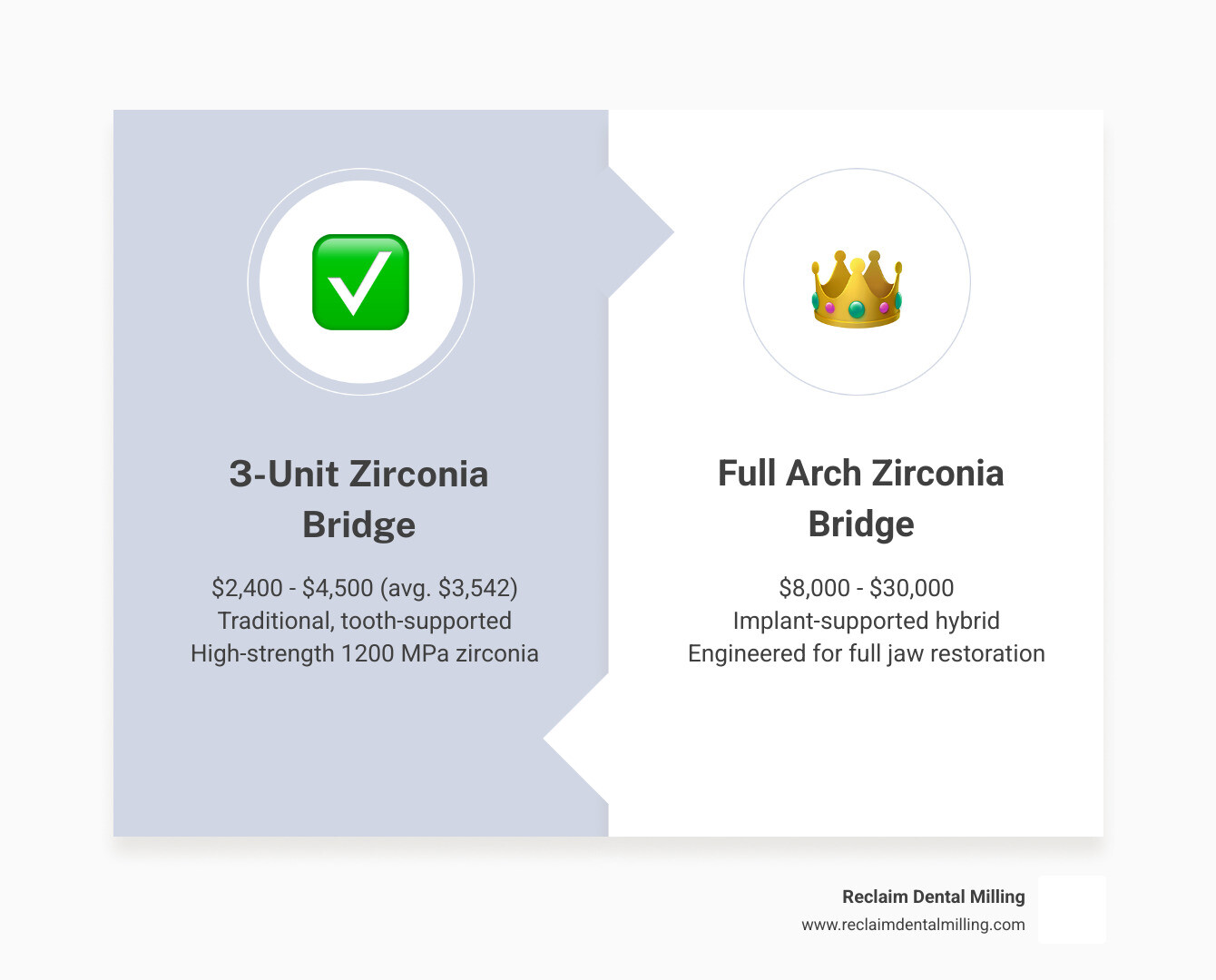
For a standard 3-unit bridge—consisting of two crowns acting as anchors and one “pontic” (the replacement tooth) in the middle—the national average sits around $3,542. However, depending on the lab and the dentist’s expertise, you might see a range between $2,400 and $4,500.
If you are looking at a per-unit cost, zirconia is generally the “premium” tier. While a Porcelain-Fused-to-Metal (PFM) bridge might be slightly cheaper upfront, the aesthetic and biocompatibility benefits of zirconia usually make it the preferred choice for modern practices.
Full Arch Hybrid Zirconia Bridge Price and Lab-Direct Options
This is where the numbers get interesting. A full arch hybrid zirconia bridge replaces an entire upper or lower set of teeth. Because this requires 4 to 6 implants and a massive amount of material, the price can climb quickly.
- Lab-Direct Starting Prices: Some high-efficiency labs offer full arch hybrid zirconia starting at $2,500 for the milling and material alone.
- Total Clinical Cost: For the patient, the total cost—including the surgery, implants, and the final bridge—typically ranges from $8,000 to $30,000 per arch.
At Reclaim Dental Milling, we focus on providing that high-end full-arch restoration without the “corporate” markup. We use 5-axis milling to ensure a passive fit, which is critical for long-term implant success. If the bridge doesn’t fit perfectly, it puts stress on the implants, leading to failure. Precision isn’t just a luxury; it’s a financial safeguard.
Factors That Influence Your Total Investment
Why does one dentist quote $3,000 while another quotes $5,000? It’s rarely just about greed. Several technical factors play into the final zirconia bridge price.

- Number of Teeth: More units equals more material and more design time. A 3-unit bridge is the baseline, but 4, 5, or 6-unit spans require significantly more reinforcement.
- Material Grade: Not all zirconia is created equal. We utilize high-strength 1200 MPa multilayered zirconia. This provides the “gradient” look of a natural tooth (darker at the neck, more translucent at the tip) while maintaining the strength needed to chew a steak.
- Lab Fees and Custom Shading: Boutique craftsmanship involves hand-staining and gingival (gum) characterization. If you want the bridge to look like it grew there, it takes a technician’s artistic eye, which adds to the lab fee.
- Complexity of the Case: If the patient has a heavy bite (bruxism) or limited vertical space, the bridge must be engineered differently to avoid fracture.
Regional Variations and Hidden Fees
Geography plays a massive role. In high-overhead markets like Manhattan, a 3-unit bridge can average nearly $3,700, with some units costing up to $5,500.
In Phoenix, Arizona, prices tend to be more competitive, but you still have to watch for “hidden” costs that aren’t always included in the initial quote:
- Consultations and X-rays: $100 – $300.
- Extractions: If a failing tooth needs to come out first, expect $200 – $500 per tooth.
- Bone Grafting: Essential if there isn’t enough bone to support an implant-supported bridge ($500 – $3,000).
- Temporary Bridges: You can’t walk around toothless while the lab works. A “temp” can add $500 – $2,000 to the total.
Comparing Zirconia to Other Bridge Materials
If you’re trying to save money, you might be tempted by other materials. But in the dental world, “cheap” often becomes “expensive” very quickly.
- Porcelain-Fused-to-Metal (PFM): These have been the standard for decades. They cost between $3,000 and $7,000 for a 3-unit bridge. The downside? That “dark line” at the gumline and the risk of the porcelain chipping off the metal frame.
- All-Ceramic (e.max): Beautiful for front teeth but lacks the “brawn” of zirconia. These are usually restricted to 3 units or fewer and aren’t ideal for back teeth where chewing forces are highest.
- Gold Alloys: Extremely durable but… well, they look like gold. They are also the most expensive option, often exceeding $5,000 – $10,000 due to the price of precious metals.
Zirconia wins because it offers the aesthetics of ceramic with the strength of metal. It’s also plaque-resistant and biocompatible, meaning your gums will stay healthier around a zirconia bridge than they might around metal.
Long-Term Value vs. Upfront Savings
A zirconia bridge typically lasts 10 to 15 years, and in many cases, even longer with proper care. When you compare the zirconia bridge price to a cheaper alternative that might need replacing every 5 to 7 years, the “expensive” option actually saves you thousands over a decade.
Maintenance is simple: brush it like a natural tooth and use a water flosser or floss threader to clean underneath the pontic. Because zirconia is so smooth, it doesn’t harbor bacteria as easily as other materials, reducing the risk of decay on the anchor teeth.
How to Make Your Zirconia Bridge More Affordable
We know that a $4,000 or $20,000 bill is a lot to swallow. However, there are ways to manage the investment.
Maximizing Insurance and Payment Plans
Most dental insurance plans classify bridges as “Major Restorative” work. Typically, they will cover about 50% of the cost, but there’s a catch: the annual maximum. Most plans cap out at $1,000 to $2,000 per year.
To maximize this:
- Split the Treatment: If you need a bridge at the end of the year, have the prep work done in December and the final bridge seated in January. This allows you to use two years’ worth of insurance maximums.
- FSA/HSA Funds: Use pre-tax dollars to pay for the bridge. This can effectively save you 20-30% depending on your tax bracket.
- Third-Party Financing: Companies like CareCredit or Proceed Finance allow you to break the cost into monthly payments.
- Dental Savings Plans: These are not insurance but membership clubs that offer 15-25% discounts on restorative work at participating dentists.
Frequently Asked Questions about Zirconia Bridges
How long does a zirconia bridge last?
With excellent oral hygiene and regular check-ups, a zirconia bridge can easily last 15 years or more. Because the material is so dense, it does not wear down like natural enamel or traditional porcelain.
Why is zirconia better than PFM or porcelain?
Zirconia is “monolithic,” meaning the whole thing is one solid piece. Traditional bridges have layers that can delaminate or chip. Furthermore, zirconia is hypoallergenic and doesn’t cause the “graying” of the gums often seen with metal-based bridges.
Conclusion
At Reclaim Dental Milling, we believe that high-quality dentistry shouldn’t be reserved for the 1%. By focusing on boutique craftsmanship and leveraging 5-axis milling technology right here in Phoenix, Arizona, we provide dentists with restorations that fit perfectly the first time.
Our 3-5 day turnaround means patients aren’t stuck in temporaries for weeks, and our precision-engineered passive fit ensures that your investment in your smile lasts for the long haul. We don’t just mill teeth; we reclaim the profitability and predictability of your restorative cases.
Ready to see the difference that precision milling makes? GET STARTED WITH RECLAIM DENTAL today and experience restorations designed for the modern practice.
Click HERE to Visit Our Most Recent Updates Click HERE to Visit Our Most Recent Updates www.labpronto.com www.labpronto.com