
Zirconia All-on-4 Milling 101
Why Zirconia All-on-4 Milling Is the Standard for Full-Arch Restorations
Zirconia All-on-4 milling is the CAD/CAM process of digitally designing and precision-cutting a full-arch implant bridge from a solid zirconia block — giving edentulous patients a fixed, biocompatible, and highly aesthetic restoration supported by just four implants.
Here’s what that means in practice:
- Four implants are placed per arch (two straight, two angled posteriorly)
- A full-arch zirconia bridge is milled to fit those implants with passive, screw-retained precision
- The result is a permanent, metal-free smile that looks natural and resists staining, chipping, and bacterial buildup
Zirconia is one of the strongest materials available in restorative dentistry — with flexural strength reaching up to 1,465 MPa — making it far more durable than acrylic or porcelain-fused-to-metal alternatives for full-arch cases.
The demand for this solution has surged. A retrospective study of 242 patients and 968 immediately loaded All-on-4 implants reported a 98% implant survival rate after five years. Patients aren’t just asking for implants — they’re asking for zirconia implants, and they’re doing their research before they walk in the door.
But here’s the problem many restorative dentists run into: not all milling is created equal. Mass-production labs rush designs, compromise on fit, and return cases that need adjustments — wasting your chair time and eroding patient trust.
That’s exactly the gap Reclaim Dental Milling was built to fill.
I’m Blake Austin — founder of Smile Now Dental Implant Center and True Impressions Dental Laboratory, with over eight years in dental implant sales and lab manufacturing, including direct work building full-arch zirconia All-on-4 milling programs for some of the largest implant centers in the country. In this guide, I’ll walk you through everything you need to know — from materials and workflow to passive fit verification and long-term outcomes.
The Science of Zirconia All-on-4 Milling Materials
When we talk about Zirconia all on 4 milling, we are discussing a material science marvel. In the early days of full-arch restorations, dentists primarily used acrylic teeth processed over a metal bar. While functional, these “hybrids” were prone to staining, wear, and the dreaded “pop-off” where teeth would delaminate from the frame.
Today, we utilize monolithic zirconia, specifically High Translucency (HT) and multi-layer varieties. These materials are milled from a single, solid puck of zirconium dioxide, ensuring there are no layers to delaminate and no metal to show through.
Flexural Strength and Durability
The primary reason we lean so heavily on zirconia is its sheer power. Standard dental zirconia offers a flexural strength of up to 1,465 MPa. To put that in perspective, the maximum biting force of a human is significantly lower, meaning these bridges are highly resistant to chips and fractures. Even our Alien HT Zirconia options boast a flexural strength of 1,200 MPa, providing a safety margin that acrylic simply cannot match.
Aesthetics and Translucency
In the past, zirconia looked like “bathroom tile”—opaque and lifeless. Modern Zirconia all on 4 milling uses multi-layer technology with a 42% translucency factor on a 1mm sample. This allows light to pass through the incisal edges just like natural enamel, while the gingival areas remain slightly more opaque to mask titanium bases or abutments.
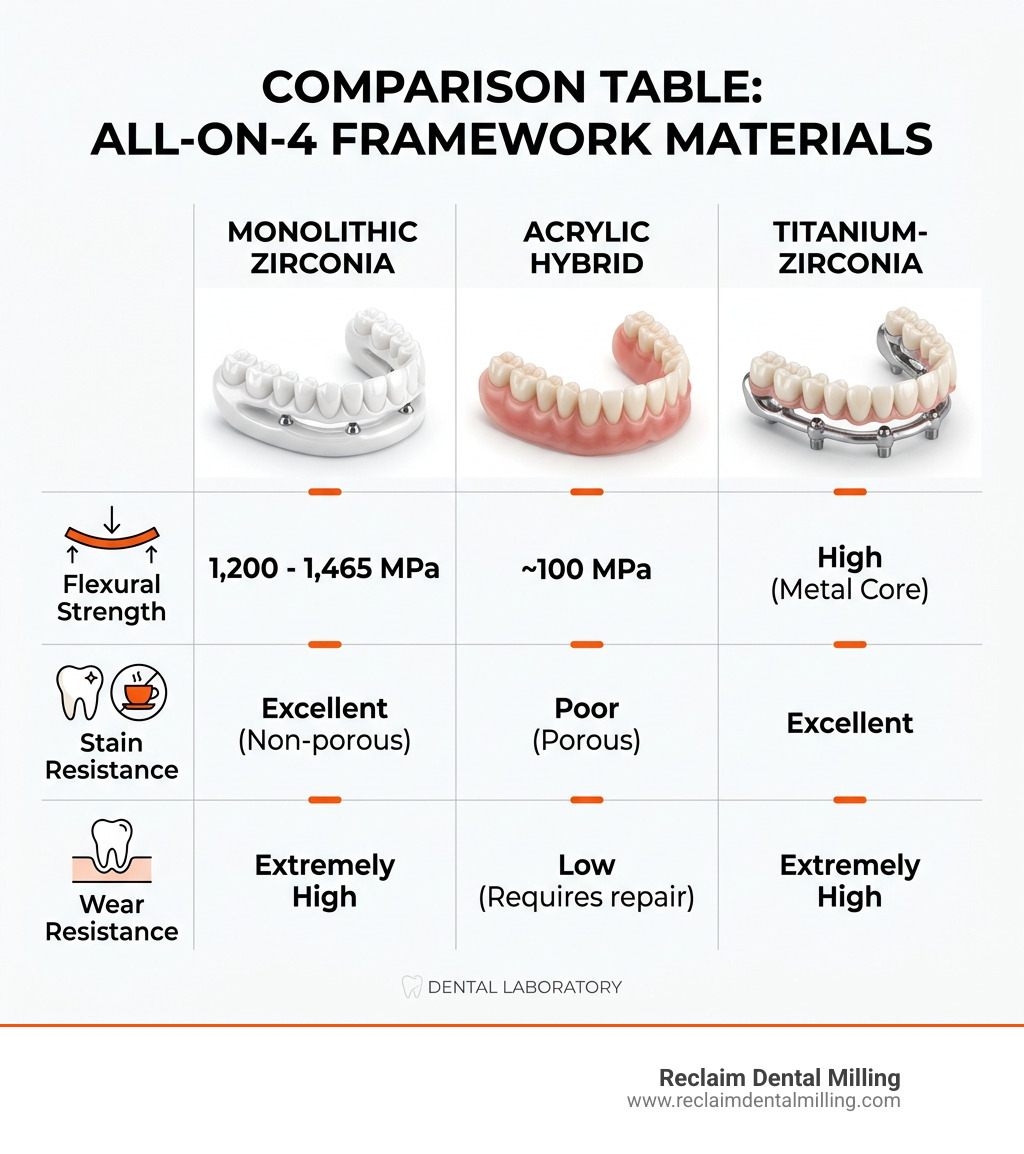
| Feature | Monolithic Zirconia | Acrylic Hybrid | Titanium-Zirconia |
|---|---|---|---|
| Flexural Strength | 1,200 – 1,465 MPa | ~100 MPa | High (Metal Core) |
| Stain Resistance | Excellent (Non-porous) | Poor (Porous) | Excellent |
| Wear Resistance | Extremely High | Low (Requires repair) | Extremely High |
| Aesthetics | Superior/Natural | Good (Initial) | Superior |
| Biocompatibility | High | Moderate | High |
Step-by-Step Workflow for Zirconia All-on-4 Milling
Achieving a perfect result requires a marriage between clinical excellence and lab precision. At Reclaim Dental Milling, we’ve refined this workflow to ensure that when the final bridge arrives at your Phoenix office, it drops in with zero stress.
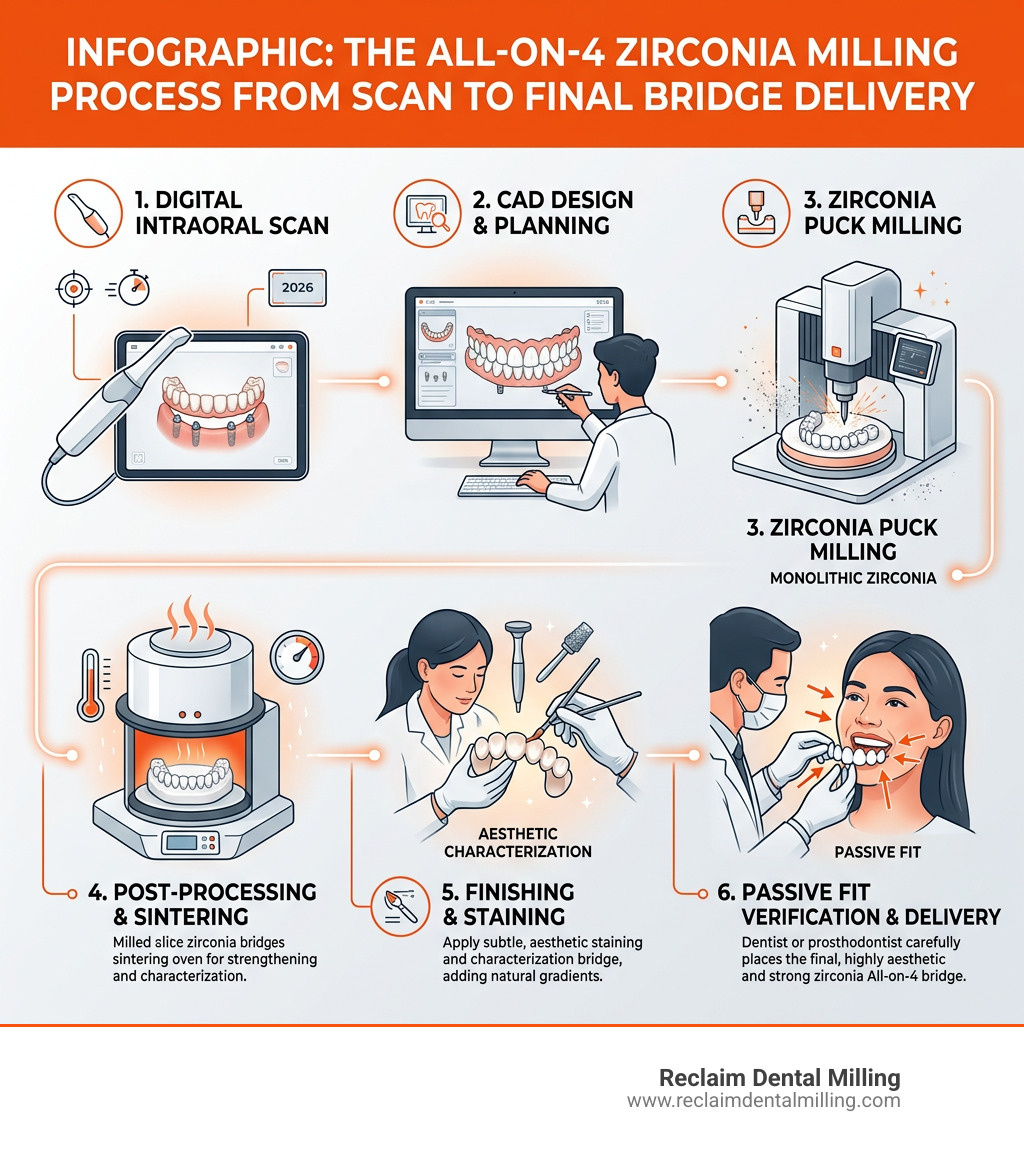
- Digital Impressions and CBCT Scans: The process begins with high-resolution intraoral scans or open-tray VPS impressions. We combine this with CBCT data to map the bone, nerves, and implant positions.
- CAD Design: We use specialized software to integrate scan bodies and virtual articulation. This ensures the bite is balanced and the “A-P spread” (Anterior-Posterior) is optimized to minimize distal cantilevers.
- Green State Milling: The bridge is milled while the zirconia is in its “green state”—a chalk-like consistency. This allows for incredibly intricate detail before the material is hardened.
- Sintering: The milled bridge is placed in a high-temperature furnace, reaching up to 1540°C. During this 8-to-12-hour cycle, the zirconia shrinks by approximately 20-25% to its final, rock-hard density.
- Turnaround: While traditional labs might take weeks, our boutique workflow in Phoenix allows for a 3-5 day turnaround on many milling stages.
Precision Design in Zirconia All-on-4 Milling
Precision starts with the STL files. We utilize extensive abutment libraries to ensure the screw channels are perfectly aligned with the multi-unit abutments (MUAs). For posterior regions, we maintain a 0.63mm minimum thickness to ensure structural integrity while allowing for enough restorative space (typically 10-14mm) to create a natural-looking emergence profile.
Custom Characterization in Zirconia All-on-4 Milling
Once the bridge is sintered, it’s not just “white teeth.” We apply custom characterization using Miyo stains and gingival shading. This allows us to mimic the natural variations in gum tissue and tooth shade. The bridge then undergoes a final 900°C glazing fire to seal the surface, making it non-porous and resistant to plaque accumulation.
Ensuring Passive Fit and Precision Verification
If the bridge doesn’t fit “passively,” the implants are under constant tension. This can lead to bone loss, screw loosening, or even implant failure. We take several steps to guarantee that your Zirconia all on 4 milling case is a perfect match for the patient’s anatomy.
The Sheffield Test
Before we ever mill the final zirconia, we provide a verification jig. This is a rigid framework that you seat in the mouth. We recommend the Sheffield Test: tighten one screw on one end and check if the other end lifts. If there is any movement, the jig is sectioned and luted back together in the mouth to capture the exact relationship. This “gold standard” ensures the final 1,465 MPa bridge won’t put lateral pressure on the implants.
PMMA Provisionals
We almost always recommend a “test drive” with a PMMA (polymethyl methacrylate) provisional. This is a milled plastic version of the final bridge. The patient wears this for 2 to 4 weeks to evaluate:
- Phonetics: Can they speak clearly (specifically “S” and “F” sounds)?
- Aesthetics: Do they like the tooth length and smile line?
- Function: Is the bite comfortable during chewing?
Once the patient and doctor sign off on the PMMA, we scan that exact shape and mill the final all-on-4 dental implants zirconia bridge to match.
Success Rates and Osseointegration
The National Association of Dental Laboratories and various clinical studies highlight that the success of these restorations is tied to the precision of the framework. With a 98% implant survival rate over five years, the All-on-4 concept is proven, but only if the prosthetic doesn’t interfere with the biological process of osseointegration.
Frequently Asked Questions about Zirconia Milling
How long does the zirconia milling process take?
Our standard lab turnaround for a milled all on 4 dental implants zirconia restoration is 3-5 days for the milling and sintering phase. However, the entire process—from initial impressions to final delivery—usually takes 4 to 6 months. This allows for the 3-6 month healing period required for the implants to fuse with the jawbone before the heavy zirconia bridge is permanently attached.
What is the typical lifespan of a milled zirconia bridge?
With proper maintenance, a milled zirconia bridge is expected to last 10 to 15 years, though the titanium implants themselves can last a lifetime. Because zirconia is non-porous, it doesn’t wear down like natural teeth or acrylic. The most common “failure” isn’t the bridge breaking, but rather the need for a professional cleaning to remove calculus from the underside of the bridge.
Is zirconia better than acrylic for All-on-4?
Yes, in almost every measurable way. Acrylic is porous, meaning it absorbs odors and stains over time (think of a plastic Tupperware container with spaghetti sauce). Zirconia is a dense ceramic that remains pristine. Furthermore, zirconia’s flexural strength of 1,200+ MPa makes it far less likely to fracture under the heavy occlusal loads of a full-arch restoration.
Conclusion
At Reclaim Dental Milling, we believe that every full-arch case is a masterpiece in the making. By focusing on boutique craftsmanship and utilizing advanced 5-axis milling technology right here in Phoenix, Arizona, we provide clinicians with the precision they need to ensure a passive fit every time.
We understand the pressures of a busy implant practice. You need a partner who offers a 3-5 day turnaround without inflated pricing, allowing you to maintain profitability while delivering a “gold standard” product to your patients. Whether you are transitioning a patient from a PMMA provisional or starting a fresh case, our team is here to ensure your Zirconia all on 4 milling results are nothing short of perfection.
Ready to experience the precision of 5-axis zirconia milling? Shop our milling services today and let’s reclaim your chair time.