
Veneers or Crowns for Your Smile Makeover
Zirconia Crowns vs Veneers: Which One Is Right for Your Smile?
Zirconia crowns vs veneers is one of the most common decisions patients and dentists face when planning a smile makeover — and the right answer depends on a few key factors.
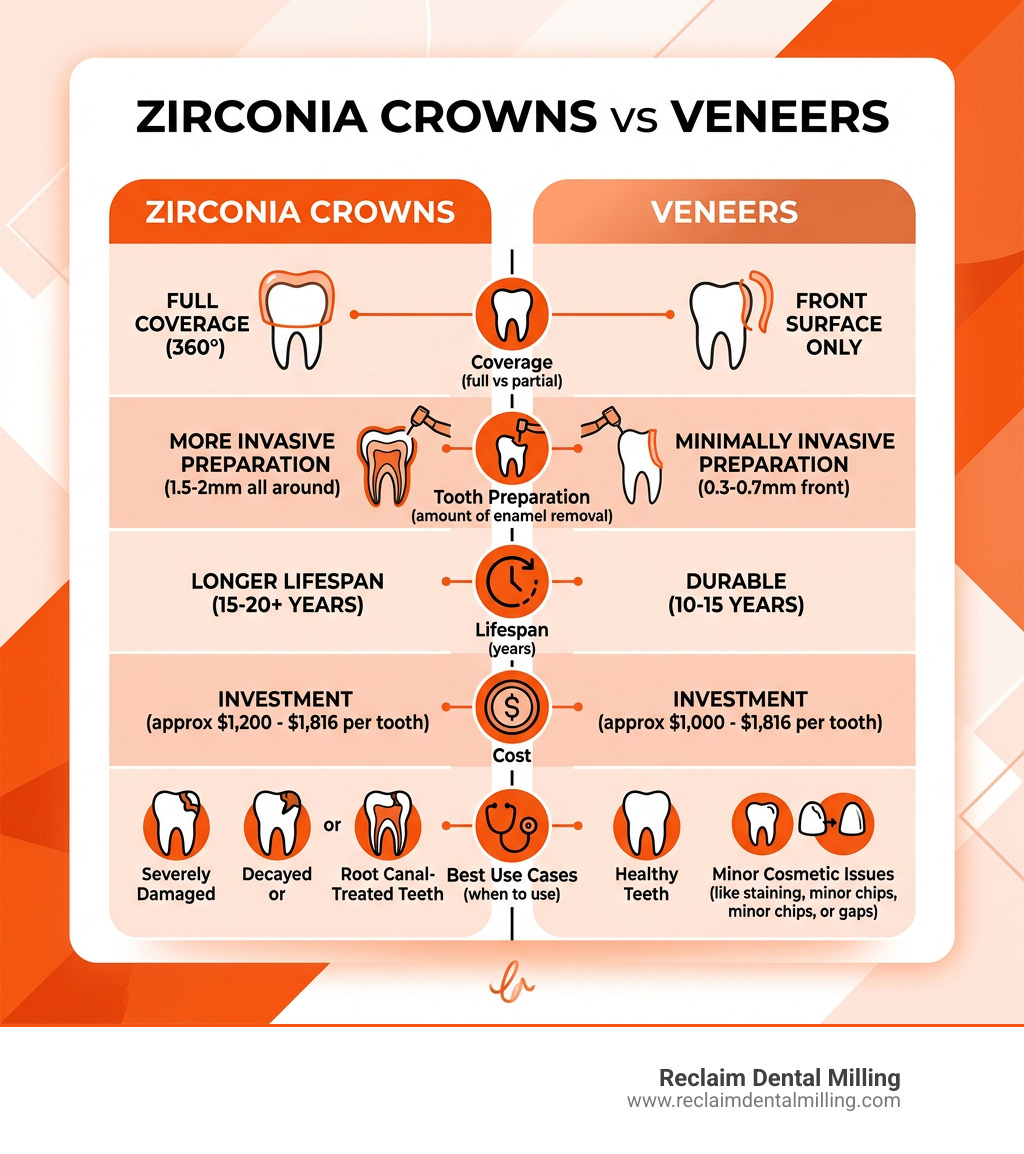
Here’s the quick breakdown:
| Zirconia Crowns | Veneers | |
|---|---|---|
| Coverage | Full tooth (360°) | Front surface only |
| Tooth Removal | 1.5–2mm all around | 0.3–0.7mm from front |
| Best For | Damaged, decayed, or root canal-treated teeth | Minor cosmetic issues on healthy teeth |
| Strength | Up to 1200 MPa | Lower — more prone to debonding |
| Lifespan | 15–20+ years | 10–15 years |
| Cost (US) | ~$1,200–$1,816 per tooth | ~$1,000–$1,816 per tooth |
| Invasiveness | More invasive | Minimally invasive |
The choice isn’t just cosmetic — it’s clinical. A tooth with severe decay or a failed root canal needs the structural protection a crown provides. A healthy tooth with surface staining or a minor chip? A veneer is often the smarter, less invasive option.
Research shows that 96% of patients consider their smile an important social asset, and 74% believe an unattractive smile can hurt career success. So getting this decision right matters — both clinically and for your patient’s confidence.
I’m Blake Austin, founder of Smile Now Dental Implant Center and True Impressions Dental Laboratory, with over eight years of hands-on experience in dental implants, restorative prosthetics, and laboratory manufacturing — including working directly with the materials and workflows behind zirconia crowns vs veneers. In this guide, I’ll cut through the confusion so you can make the most informed choice for each case.
Understanding Zirconia Crowns vs Veneers
When we talk about zirconia crowns vs veneers, we are comparing two very different levels of “armor” for your teeth. Think of a veneer as a custom-made, ultra-thin shell (similar to a contact lens or a false fingernail) that we bond only to the front of the tooth. A zirconia crown, on the other hand, is a “helmet” or a cap that completely encases the tooth 360 degrees down to the gum line.
The primary difference lies in the amount of natural tooth structure we have to remove to make room for the restoration. For a veneer, we typically only need to shave away about 0.3mm to 0.7mm of the front enamel. This is incredibly conservative and preserves over 80% of the tooth’s natural healthy enamel.
However, for a zirconia crown, the preparation is more significant. We usually need to reduce the tooth by 1.5mm to 2.0mm all the way around. This means removing about 60% to 75% of the tooth’s natural structure. While that sounds like a lot, it is often necessary to provide enough room for the zirconia material to be thick enough to withstand heavy biting forces, especially on molars.
Why does this matter? According to recent research, a luminous smile can greatly boost self-esteem in social situations. White, straight, and impeccably aligned teeth are a synonym for self-care. Choosing the right restoration ensures that the smile doesn’t just look good, but stays healthy for decades.

Comparison Table: Zirconia Crowns vs Veneers
| Feature | Zirconia Crown | Veneer (Porcelain/Zirconia) |
|---|---|---|
| Primary Goal | Restoration & Protection | Cosmetic Enhancement |
| Thickness | ~1.5mm – 2mm | ~0.3mm – 0.7mm |
| Preparation | Full 360° reduction | Front surface reduction only |
| Bonding | Mechanical and Chemical | High-strength Chemical Bonding |
| Reversibility | Irreversible | Irreversible (usually) |
| Failure Mode | Recurrent decay or fracture | Debonding or chipping |
The Material Science: Why Zirconia Stands Out
At Reclaim Dental Milling, we work with zirconia every day because it is essentially the “ceramic steel” of dentistry. Zirconia (zirconium dioxide) is a biocompatible crystalline material that is actually used in other medical fields for things like artificial hip joints because of its extreme wear resistance.
In zirconia crowns vs veneers, zirconia’s tensile strength is its biggest bragging right. It can reach up to 1200 MPa, which is vastly stronger than traditional porcelain. It also has a fracture toughness of up to 9 MPa, meaning it is much less likely to crack under the pressure of a heavy “biter” or someone who grinds their teeth at night.
Historically, the knock against zirconia was that it looked “flat” or too opaque—kind of like a bathroom tile. However, newer zirconia materials have recently been created which are more translucent than ever before. These modern formulations allow light to pass through the restoration similarly to natural tooth enamel, mimicking the natural color and lustre of real teeth.
Aesthetic Performance of Zirconia Crowns vs Veneers
Aesthetics are where the battle of zirconia crowns vs veneers gets interesting. Historically, porcelain veneers were the gold standard for beauty because they were naturally more translucent. But zirconia has caught up.
Newer, high-translucency zirconia formulations often mix in small amounts of aluminum and lithium dioxide to improve light transmission. Research on newer translucent zirconia shows that while older versions only had about 70% of the translucency of lithium disilicate (a popular aesthetic ceramic), modern zirconia is closing that gap rapidly.
One major advantage of zirconia, especially for crowns, is its gingival (gum) compatibility. Zirconia is highly biocompatible and smooth, which prevents the “dark line” at the gum line often seen with older porcelain-fused-to-metal (PFM) crowns. It also resists plaque buildup, which helps keep the surrounding gum tissue healthy and pink.
Choosing the Right Restoration for Your Dental Needs
The decision between zirconia crowns vs veneers usually comes down to how much healthy tooth is left. We like to say: “Veneers for beauty, crowns for duty.”
If you have a tooth that has undergone a root canal, it becomes brittle over time. A veneer won’t protect it from snapping. In that case, a zirconia crown is the only responsible choice because it reinforces the tooth’s structural integrity. Similarly, if a tooth has a very large filling or severe decay that has eaten away a significant portion of the enamel, a crown provides the necessary “hug” to keep the tooth together.
For those curious about the physical steps, you can see what the dental crown procedure looks like to get a better visualization of the 360-degree preparation.
When to Opt for Zirconia Crowns vs Veneers
Choose Zirconia Crowns if you have:
- Bruxism (Teeth Grinding): If you grind your teeth, veneers are at a high risk of “debonding” (popping off) or chipping. Zirconia crowns can withstand those massive grinding forces.
- Severe Damage: Teeth with large cracks, deep decay, or those that have been root-canal treated.
- Bite Correction: If we need to change the way your upper and lower teeth meet (the occlusion), crowns give us more control over the tooth’s shape.
- Molar Reinforcement: Back teeth do the heavy lifting of chewing; they almost always require crowns rather than veneers.
Choose Veneers if you have:
- Minor Discoloration: For teeth that are stained from coffee, tea, or smoking and don’t respond to whitening.
- Small Gaps (Diastema): Veneers can elegantly close small gaps between front teeth without the need for braces.
- Minor Chips or Wear: If the tooth is structurally sound but the edges look “eaten away” or jagged.
- Slight Misalignment: Often called “instant orthodontics,” veneers can make slightly crooked teeth look perfectly straight.
Longevity, Cost, and Maintenance
When comparing the lifespan of zirconia crowns vs veneers, zirconia crowns generally take the lead. On average, a well-maintained zirconia crown can last 15 to 20+ years. Some studies even suggest they can last 25 years or more because the material is so resistant to fracture (with a fracture rate of less than 3-5%).
Veneers are no slouch, typically lasting 10 to 15 years. However, they are more prone to “debonding”—which is a fancy way of saying the glue fails and the shell falls off. The debonding failure rate for veneers is roughly 12-15% over a decade, whereas crowns rarely have this issue because they sit over the tooth like a cap.
Cost Variations
In the United States, and specifically in the Phoenix area, the costs for these procedures are relatively similar per tooth, though crowns are often slightly more expensive due to the laboratory time and material volume involved.
- Zirconia Crowns: $1,200 – $1,816 per tooth.
- Porcelain/Zirconia Veneers: $1,000 – $1,816 per tooth.
While you might see lower prices advertised in places like Turkey, we always remind our partners and patients that the precision of the fit is what determines how long the restoration lasts. At Reclaim Dental Milling, we use 5-axis milling to ensure a “passive fit”—meaning the crown or veneer drops into place perfectly without putting stress on the tooth. A poorly fitted “bargain” crown often leads to recurrent decay (cavities under the crown), which has a 10% failure rate in some evaluations.
Maintenance Requirements
Maintaining your new smile isn’t difficult, but it does require consistency:
- Non-Abrasive Toothpaste: Use a soft-bristled brush and toothpaste that isn’t loaded with harsh abrasives, which can dull the polish of the zirconia over many years.
- Nightguards: If you have invested in a full smile makeover, a custom nightguard is your best friend. It acts as an insurance policy against nocturnal grinding.
- Flossing: You can still get a cavity at the “margin” (where the crown/veneer meets the natural tooth). Flossing daily is non-negotiable.
- Avoid “Tools, not Jewels”: Don’t use your teeth to open packages, bite your nails, or chew on ice. Even the strongest zirconia can be stressed by improper use.
Frequently Asked Questions about Smile Restorations
Can zirconia crowns and veneers be combined in one treatment plan?
Absolutely! In fact, this is how we handle many “Full Arch” cases. We might place zirconia crowns on the back molars for strength and use veneers on the front six or eight teeth for a more conservative, aesthetic result. The key is “shade matching.” Because we mill our restorations using high-end digital scanners and 5-axis machines, we can ensure the color and translucency of the crowns match the veneers perfectly, creating a seamless, uniform smile.
What is the price difference between zirconia crowns and veneers?
Usually, the price difference is minimal—often within $100 to $300 of each other. However, veneers are typically not covered by dental insurance because they are considered “cosmetic.” Crowns, however, are often partially covered (sometimes up to 50%) if the dentist can prove the tooth is structurally compromised or decayed. This often makes a zirconia crown the more affordable out-of-pocket option for the patient.
Do zirconia crowns look as natural as porcelain veneers?
With modern “Multi-Layered” zirconia, yes. Older zirconia was one solid color. Today’s zirconia blocks are “gradiented,” meaning they are darker and more opaque at the bottom (near the gum) and become lighter and more translucent at the biting edge—just like a real tooth. While a master ceramist can still achieve slightly more detail with hand-layered porcelain veneers, 99% of people will never be able to tell the difference between a high-quality zirconia crown and a veneer.
Conclusion
The debate of zirconia crowns vs veneers isn’t about which one is “better,” but which one is right for the specific tooth in question. If you have healthy, strong teeth and just want to fix the “look,” veneers are a fantastic, conservative choice. If your teeth have been through the ringer—decay, cracks, or old root canals—zirconia crowns provide the robust protection you need to keep your smile for a lifetime.
At Reclaim Dental Milling in Phoenix, Arizona, we specialize in the “Boutique Craftsmanship” of these restorations. We don’t believe in the “one-size-fits-all” approach. By using precision 5-axis milling and high-translucency zirconia, we provide our dentists with restorations that have a passive fit and a 3-5 day turnaround. This means less time in temporary crowns for the patient and a more profitable, predictable workflow for the clinic.
Whether you are a patient looking to transform your confidence or a dental professional seeking better restorative outcomes, the choice of material and milling precision is the foundation of a successful smile. Ready to start your smile transformation? Consult with your dental provider today and ask about the precision-milled zirconia options available through Reclaim Dental Milling.