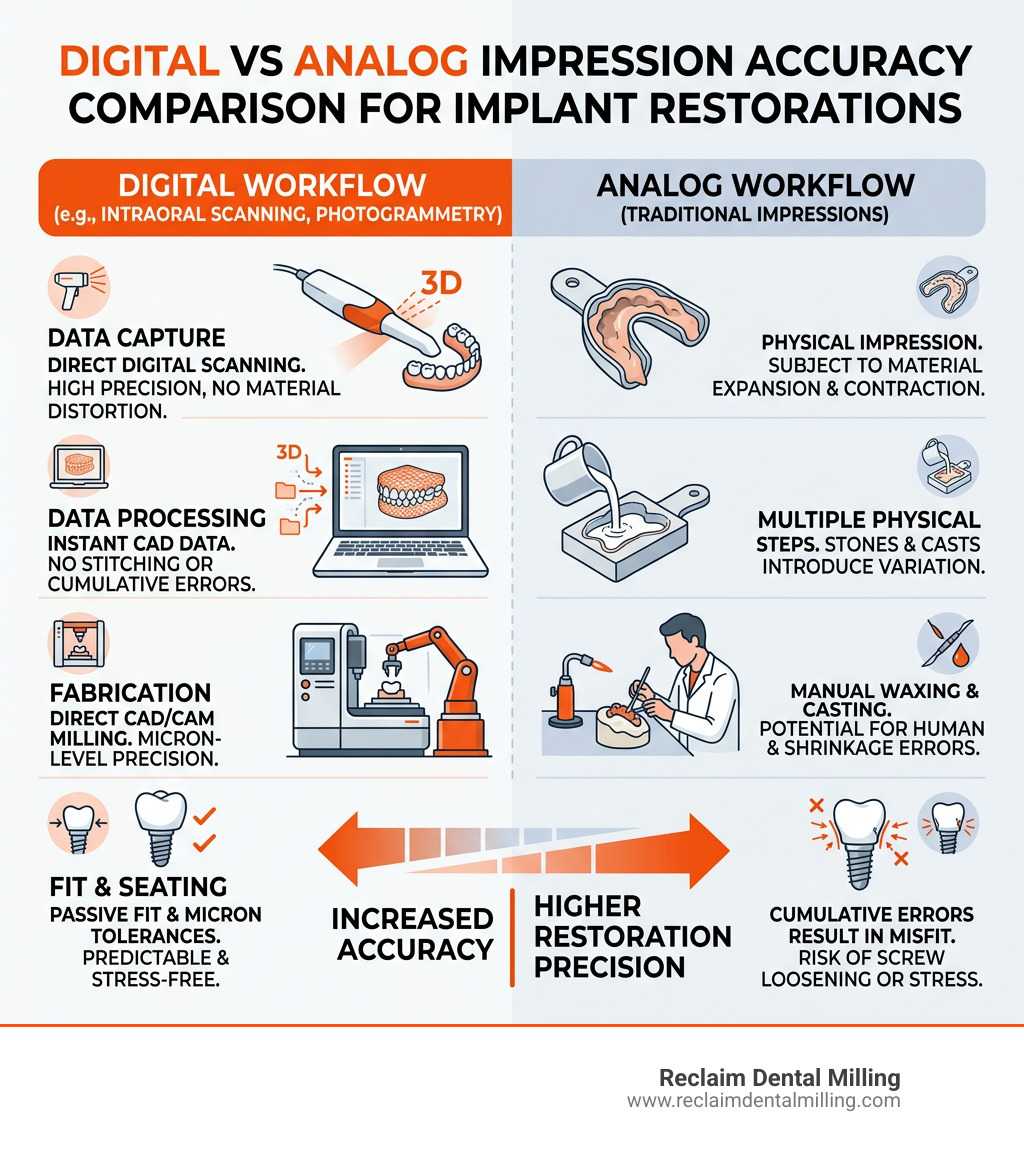
How Digital Impressions Lead to High Accuracy Restorations
Why High Accuracy Implant Restorations Define Long-Term Implant Success
High accuracy implant restorations are prosthetic solutions — crowns, bridges, and full-arch reconstructions — designed and milled to micron-level precision so they seat passively on implants without stress, gaps, or misfit.
Here’s what makes a restoration “high accuracy”:
- Passive fit — the prosthesis seats fully on implants with zero tension or rocking
- Dimensional tolerances of ±5μm or better — achieved through CAD/CAM milling and 100% inspection
- Digital impression workflow — intraoral scanning or photogrammetry replaces error-prone analog impressions
- Verified seating — confirmed radiographically and clinically before final delivery
- OEM (genuine) components — engineered to match the implant system precisely
Why does this matter? Because 33.6% of patients with implant crowns will experience complications within 5 years. Poor fit is one of the leading drivers — causing screw loosening, bone stress, and framework fracture.
The gap between a restoration that looks like it fits and one that actually fits passively is where most failures begin.
I’m Blake Austin, founder of Smile Now Dental Implant Center and True Impressions Dental Laboratory, with over eight years in dental implants sales and business development — including territory management for Nobel Biocare and senior roles at the Straumann Group — giving me a front-row view of what separates predictable high accuracy implant restorations from the ones that come back as complications. In this guide, I’ll walk you through the exact digital workflows, materials, and protocols that make precision restorations repeatable.
The Science of Intraoral Photogrammetry in High Accuracy Implant Restorations
When we talk about high accuracy implant restorations, we have to address the “elephant in the room”: the cumulative error of traditional impressions. In the past, we relied on stone models and physical transfers, which were subject to expansion, contraction, and human error. Even standard intraoral scanners can struggle with “stitching errors” when trying to span a full edentulous arch.
This is where intraoral photogrammetry changes the game. Unlike a standard video-based scan that pieces together thousands of small images, photogrammetry uses specialized hardware to capture the precise 3D spatial relationship of implants using coded scanbodies (often called scan flags). This technology achieves micron-level precision that is essentially unattainable with analog methods.
According to a systematic review on photogrammetry technology, this method demonstrates superior trueness and reproducibility for complete-arch impressions. By capturing the exact position of Multi-Unit Abutments (MUAs) in a single mathematical “snapshot,” we eliminate the distortions that lead to ill-fitting bridges.
Photogrammetry vs. Conventional Intraoral Scanning
| Feature | Intraoral Photogrammetry | Conventional Intraoral Scanning |
|---|---|---|
| Primary Use | Full-arch implant positioning | Single units, quadrants, soft tissue |
| Accuracy | Micron-level (±5μm to 10μm) | Variable over long spans (stitching error) |
| Speed | Extremely fast for implant data | Slower for full-arch edentulous spans |
| Verification | Highly reproducible | Requires verification jigs for full-arch |
By utilizing photogrammetry, we ensure that the digital file sent to the mill is a perfect replica of the patient’s mouth. This is the first and most critical step in creating high accuracy implant restorations.
Achieving Passive Fit through Advanced Digital Workflows
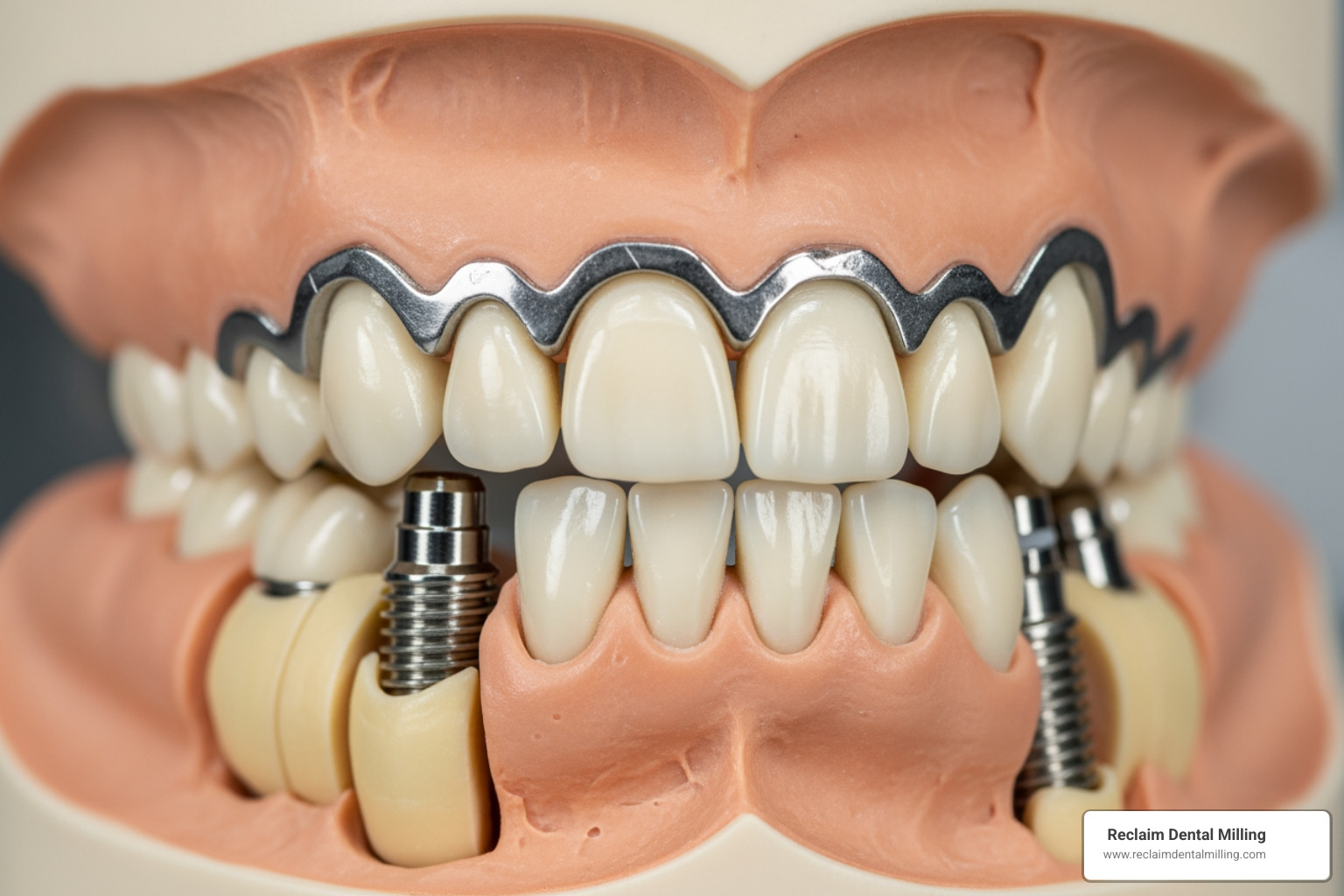
In All-on-4 and All-on-X, “passive fit” is our North Star. A passive fit means that when the bridge is placed on the implants, there is zero tension transmitted to the implants or the surrounding bone before the screws are even tightened.
If a framework has even a slight marginal discrepancy, tightening the screws creates “clamping force” that can lead to biological failures (bone loss) or mechanical failures (screw stripping and bridge fractures). Research on marginal discrepancy in zirconia frameworks highlights that even microscopic misfits can compromise the long-term health of the implant-bone interface.
To verify this in the clinic, we use the “Sheffield Test” (or one-screw test). We thread a single screw into one terminal implant and check for any lift or gap at the other end of the bridge. If the bridge stays perfectly seated, we know we have achieved the precision required for a long-term win.
The Role of 5-Axis Milling in High Accuracy Implant Restorations
At Reclaim Dental Milling, we believe that the best digital design is only as good as the machine that cuts it. This is why we specialize in 5-axis milling for all our All-on-4 and full-arch zirconia/titanium restorations.
While a 3-axis mill moves in three directions (X, Y, and Z), a 5-axis mill adds two rotational axes. This allows the milling tool to approach the restoration from any angle, which is absolutely vital for:
- Complex screw access holes: Especially when using angled screw channels (ASC) to move the exit hole away from the biting edge or esthetic zone.
- Undercuts and fine details: Ensuring the titanium inserts or MUA connections seat with zero friction.
- Boutique craftsmanship: We don’t just “hit print.” Every case is handled with a focus on precision engineering.
Operating out of Phoenix, Arizona, we provide a 3-5 day turnaround. Our goal is to help your practice remain profitable without the inflated pricing often found at “big box” national labs, all while maintaining the highest standards for high accuracy implant restorations.
Material Innovations for Fracture Resistance and Esthetics
Precision isn’t just about fit; it’s about the material’s ability to withstand the forces of the human jaw. Traditional acrylic hybrids often suffer from “shearing,” where the teeth pop off the bar. Modern high accuracy implant restorations utilize advanced materials that are both stronger and more esthetic.
High-Performance Materials
- Flexcera Ultra+: We utilize this 3D-printed material for long-term provisionals and PMMA hybrids. It is 3x more fracture resistant than traditional denture materials, making it ideal for the healing phase.
- Crystal Ultra: This material is a game-changer for patients who want a lighter feel. It is 60% lighter than Zirconia but 6x stronger than traditional acrylic. A major advantage of Crystal Ultra is that it is easily repairable chairside with composite if a chip ever occurs.
- NobelProcera Zirconia: For final restorations, monolithic zirconia offers incredible wear resistance. A study on zirconia abutment survival shows excellent prosthetic survival rates over five years, confirming that when milled correctly, these materials are built to last.
By combining these materials with meticulous gingival contouring—shaping the “pink” part of the bridge to support the patient’s lip and soft tissue—we achieve what we call “Esthetic Excellence.”
Clinical Protocols for Digital Data Capture
To get a high-accuracy result, the clinical input must be flawless. This starts with “Prosthetically Driven Planning.” We don’t just place implants where the bone is; we place them where the teeth need to be.
Using a virtual patient model—which integrates CBCT bone data, intraoral scans of the soft tissue, and face scanning (like MetiSmile) for lip-line analysis—we can design the smile before the first incision is made.
Step-by-Step Guide to Capturing High Accuracy Implant Restorations
Capturing accurate data shouldn’t be stressful. Follow these steps to ensure your lab has everything they need:
- Site Preparation: Ensure the tissue is healthy and free of debris. If the gingiva has overgrown the healing abutment, recontour it to ensure the scan body seats fully.
- Scan Body Selection: Use genuine OEM scan bodies whenever possible. Titanium or PEEK scan bodies with flat indexing features are easiest for the scanner to “read.”
- Seating Verification: This is the most common point of failure. Always verify the scan body seating visually and radiographically. A 1mm gap at the scan stage equals a massive misfit at the final stage.
- Capture the Emergence Profile: Immediately after removing the healing abutment, scan the “gingival cuff” before the tissue collapses. This helps us design a crown that looks like it’s growing out of the gum.
- Digital Design Approval: At Reclaim Dental Milling, we share our designs with you for approval before we mill. This communication ensures the occlusion and esthetics meet your standards.
Verification Checklist for Passive Fit:
- [ ] Radiograph confirms scan body is fully seated.
- [ ] Scan includes 3-5mm of soft tissue around the implant.
- [ ] Bite registration is captured at the correct vertical dimension (VDO).
- [ ] (For Full Arch) Photogrammetry or verification jig data is included.
Frequently Asked Questions about Implant Precision
Why is passive fit critical for full-arch cases?
In a full-arch bridge, the implants are splinted together. If the bridge is not a perfect match for the implant positions, the framework will act like an orthodontic appliance, constantly pulling on the implants. This leads to “angry gums,” bone loss, and eventually, the loss of the implants themselves. High accuracy implant restorations prevent this by ensuring the framework sits “dead in the water” before the screws are tightened.
What are the benefits of OEM components over aftermarket?
While aftermarket components are available, scientific data shows that implant success is heavily influenced by the precision of the implant-to-abutment interface. NobelProcera components, for example, are engineered as a complete system with tolerances as low as ±5μm. Using “knock-off” parts can lead to uncontrolled forces and mechanical failure. At Reclaim, we prioritize OEM components to protect your clinical reputation.
How does digital planning prevent common complications like screw stripping?
Most screw stripping happens because the screw hole is poorly aligned, forcing the clinician to use excessive torque or an awkward angle. Digital planning allows us to use technologies like the Powerball Screw or Angulated Screw Channels. This provides up to 25-30 degrees of correction, ensuring the driver fits perfectly into the screw head, even in the tightest posterior spaces.
Conclusion
The transition from analog to digital isn’t just about “going paperless”—it’s about elevating the standard of care. By embracing intraoral photogrammetry, 5-axis milling, and advanced materials like Flexcera Ultra+, we can virtually eliminate the common complications that have plagued implant dentistry for decades.
Predictable outcomes and high patient satisfaction are the natural results of a high-accuracy workflow. Whether you are doing a single lateral incisor or a bimaxillary All-on-4, the precision of the digital impression is the foundation of long-term success.
Are you ready to experience the difference that boutique craftsmanship and precision engineering can make for your practice? Based right here in Phoenix, Arizona, our team is ready to help you deliver the next level of care.
Start your high-accuracy case with Reclaim Dental Milling today.