
Buying a 5 Axis Dental Mill Without the Headache
The Right 5-Axis Dental Milling Machine Changes Everything in Your Lab
A 5-axis dental milling machine is a CNC (computer-controlled) cutting device that moves along five directions — X, Y, Z (linear) and A, B (rotary) — to mill precise dental restorations from a digital file. It’s the gold standard for full-arch implant cases, crowns, bridges, abutments, and surgical guides.
Quick answer — here’s what you need to know:
- What it does: Mills crowns, bridges, abutments, veneers, full-arch prosthetics, and surgical guides from materials like zirconia, titanium, PMMA, and PEEK
- How it differs: 3- and 4-axis machines can’t reach complex undercuts without repositioning; 5-axis machines handle them in a single setup
- Key specs to compare: Spindle speed (30,000–80,000 RPM), spindle power, accuracy (as tight as ±0.003 mm), and automation level
- Top models: Roland DWX-52Di, VHF R5, BLZ MO150, Versamill 5X-500L, JD-TX5
- Price range: Roughly $6,000 on the low end to $70,000+ for high-automation lab machines
If you’re a restorative dentist tired of getting full-arch cases back with poor fit and inconsistent quality, the machine behind those restorations matters a lot. A capable 5-axis mill — paired with skilled technicians — is what separates boutique precision from mass-production mediocrity.
I’m Blake Austin, founder of True Impressions Dental Laboratory and a former senior business development manager in the dental implants industry, where I helped build out high-end labs specifically around 5-axis dental milling machine workflows for full-arch implant cases. In the sections below, I’ll walk you through exactly what to look for so you can make a confident, well-informed decision.
Understanding the 5-Axis Dental Milling Machine Advantage
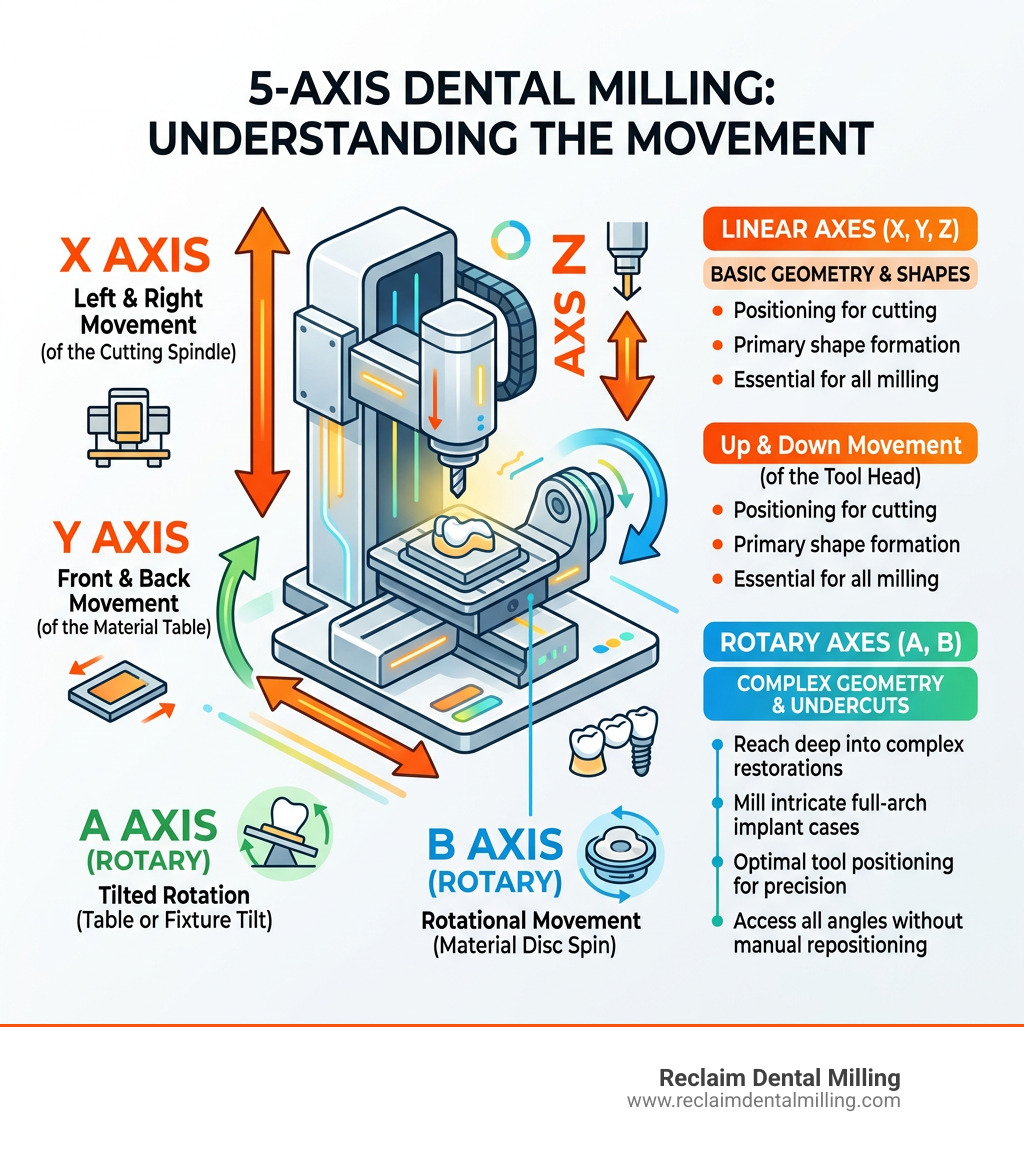
When we talk about “axes,” we are talking about the directions in which the cutting tool or the material can move. In a standard 3-axis machine, you have X, Y, and Z (left-to-right, front-to-back, and up-and-down). While great for simple shapes, these machines struggle with the organic, complex curves of human teeth and the deep undercuts found in dental implants.
A 5-axis dental milling machine adds two rotary axes, usually labeled A and B. This allows the machine to tilt and rotate the material disc or the spindle itself. Why does this matter? It means the cutting tool can reach every nook and cranny of a restoration without the technician having to stop the machine and manually reposition the part.
By utilizing 5-axis CNC machining, labs can eliminate the “shadow areas” that 3-axis machines simply can’t reach. This geometric flexibility is the secret sauce behind digital technology in modern dentistry. With a B-axis that can often tilt up to ±30 or ±35 degrees, the machine can “look” into deep undercuts, ensuring that the internal fit of a crown or the screw channel of an abutment is milled to perfection.
Why Your Lab Needs a 5-axis dental milling machine
If you are still on the fence about whether to upgrade, consider the impact on your daily workflow:
- Setup Reduction: Because the machine can reach almost any angle, you don’t need multiple setups for one piece. You put the material in, and the machine does the rest.
- High Precision: Simultaneous movement of all five axes ensures a smoother surface finish. This means less time spent “hand-finishing” or polishing at the bench.
- Complex Geometries: For All-on-4 or full-arch cases, a 5-axis mill is non-negotiable. It provides the passive fit required for long-term implant success.
- Surgical Guides: Milling surgical guides requires high accuracy to ensure implant placement matches the digital plan exactly.

Key Features to Look for in a 5-axis dental milling machine
Not all mills are created equal. When we evaluate a 5-axis dental milling machine, we look at the “heart” of the machine: the spindle.
The spindle is what holds and spins the cutting bur. A high-speed spindle, like those found in advanced Roland milling technology, typically operates between 30,000 and 80,000 RPM. Higher RPMs generally allow for cleaner cuts in harder materials, while higher wattage (power) ensures the machine doesn’t “bog down” when milling tough metals like titanium or Chrome Cobalt.
What to prioritize:
- Automatic Tool Changer (ATC): Look for a capacity of at least 10 to 20 tools. This allows the machine to switch from a heavy “roughing” bur to a tiny “finishing” bur automatically, enabling unattended overnight production.
- Haptic Measuring: This feature allows the machine to physically “touch” the tool to verify its length and wear. If a tool breaks, the machine knows immediately and can switch to a backup.
- Ionizers: Especially important for dry milling PMMA or wax, ionizers neutralize static electricity so that plastic “snow” doesn’t clog the machine.
Comparing the Best 5-axis dental milling machine Models
Choosing a model depends on your lab’s volume and the materials you plan to mill. Here is a breakdown of the heavy hitters currently on the market:
- Roland DWX-52Di: A fantastic “workhorse” for many labs. It features a 30,000 RPM spindle and a unique C-Clamp adapter that allows you to mill up to 31 single units per disc by utilizing the very edges of the material.
- VHF R5: This is a high-end, highly automated solution. It boasts an 80,000 RPM spindle and ±0.003 mm repetition accuracy. Its “DirectClean” technology allows it to switch between wet and dry milling seamlessly by self-cleaning and drying the chamber.
- BLZ MO150: A powerful contender with a 60,000 RPM spindle and 1800 watts of power. It’s designed for speed and stability, making it a favorite for high-volume zirconia production.
- Versamill 5X-500L: If you need a “tank,” this is it. Weighing 470kg with a cast aluminum-alloy frame, it’s built to absorb vibrations. Its 3Kw spindle is powerful enough to mill titanium and stainless steel all day long.
- JD-TX5: Known for its impressive speed, this machine can turn out a zirconia crown in as little as 9 to 18 minutes while maintaining a positioning accuracy of 0.003 mm.
Material Versatility and Clinical Applications
The beauty of a 5-axis dental milling machine is that it isn’t a one-trick pony. Depending on whether you choose a wet, dry, or hybrid system, you can process a massive range of materials.
- Zirconia: The most common material for Crowns. 5-axis mills ensure that the margins are razor-sharp.
- Titanium & Cobalt Chrome: Used for Abutments and implant frameworks. These require a robust, high-torque spindle and usually wet milling.
- PMMA & Wax: Ideal for Bridges and temporary/provisional restorations.
- Glass Ceramics: Materials like e.max require wet grinding to prevent fracturing.
- Specialty Materials: PEEK (for lightweight frameworks) and even gypsum for digital models.
From simple Veneers to complex Copings and full-arch prosthetics, the 5-axis mill handles it all.
Critical Selection Factors: Wet vs. Dry and Automation
One of the biggest debates in dental milling is Wet vs. Dry.
Dry milling is generally faster and easier to clean, making it the standard for zirconia and wax. However, wet milling is essential for metals and glass ceramics to keep the material and tools cool. Interestingly, some experts argue that wet-machining zirconia actually leads to longer tool life and better surface finishes, as the “sludge” created is less abrasive than dry zirconia dust.
Automation is the next frontier. Modern machines now offer features like:
- Automatic Disc Changers (ADC): Machines like the Roland DWX-53DC can hold up to six material discs. This allows the lab to mill different cases (e.g., a zirconia bridge followed by a PMMA temp) without any human intervention.
- Remote Monitoring: Software like DGSHAPE CLOUD allows us to monitor the mill’s progress, tool life, and maintenance needs from a smartphone.
- Open Architecture: We always recommend open systems. This gives you the freedom to choose your preferred CAD software, scanners, and materials rather than being locked into one manufacturer’s ecosystem.
Frequently Asked Questions about 5-Axis Milling
How much does a 5-axis dental mill cost?
The price varies wildly based on automation. Entry-level 5-axis mills can start around $25,000. However, for a high-production lab machine with an automatic disc changer and the ability to mill titanium, you can expect to pay between $50,000 and $70,000+. When calculating ROI, don’t just look at the sticker price—consider the labor savings from 24-hour unattended production.
What is the difference between 4-axis and 5-axis milling?
A 4-axis machine can rotate the material, but it cannot tilt it. This means it still struggles with deep undercuts. A 5-axis machine’s ability to tilt (the B-axis) by ±30 to 35 degrees allows the cutting tool to reach angles that are physically impossible for a 4-axis machine. This is critical for complex implant cases where the screw access hole might be at a difficult angle.
How accurate are these machines?
Top-tier mills offer a repetition accuracy of ±0.003 mm (3 microns). To put that in perspective, a human hair is about 50 microns thick. This level of precision is what ensures a “passive fit” for full-arch bridges, meaning the restoration drops into place without any tension on the implants.
Conclusion
Investing in a 5-axis dental milling machine is a commitment to quality and efficiency. At Reclaim Dental Milling, we’ve built our reputation on this exact technology. Based in Phoenix, Arizona, we specialize in high-end All-on-4 and full-arch zirconia and titanium restorations.
We combine boutique craftsmanship with the industrial power of 5-axis milling to deliver a 3-5 day turnaround without the inflated pricing of traditional labs. Whether you are looking for a single crown or a complex full-arch implant bridge, our focus is always on precision and a perfect fit.
Ready to see the difference a precision-milled restoration can make for your patients? Order your next case from Reclaim Dental Milling today.