
Building Better Bars with 5 Axis Technology
Why 5 Axis Implant Frameworks Set the Standard for Full-Arch Precision
5 axis implant frameworks are prosthetic structures — typically bars, bridges, or hybrid restorations — milled from high-performance materials like titanium or chrome-cobalt using a CNC machine that moves simultaneously across five directions: X, Y, Z, A, and B.
Here’s what that means for your full-arch cases at a glance:
| Feature | What It Means for You |
|---|---|
| 5-axis movement | Cuts complex angles and undercuts in a single setup |
| Passive fit | Minimal stress on implants — critical for long-term success |
| Subtractive milling | Consistent material density vs. casting or printing |
| Material options | Titanium, Co-Cr, Zirconia, PEEK, PMMA |
| Accuracy | Deviations as low as 0.41 mm vertical vs. over 1.68 mm with printed guides |
For restorative dentists managing full-arch implant cases, the difference between a well-milled bar and a poorly fabricated one shows up fast — in adjustments, in patient discomfort, and in long-term implant health.
Mass-production milling centers often cut corners. Frameworks come back with poor passive fit, inconsistent margins, and designs that weren’t built around your patient’s anatomy. That’s a problem you shouldn’t have to solve at the chair.
5-axis technology changes what’s possible in framework fabrication. It’s not just about the machine — it’s about what that machine enables: tighter tolerances, cleaner geometry, and restorations that seat the way they’re supposed to.
I’m Blake Austin, founder of True Impressions Dental Laboratory and a former territory manager with Nobel Biocare and Straumann Group, where I worked hands-on with dental offices producing 5 axis implant frameworks at the highest level. That background shapes everything about how Reclaim Dental Milling approaches precision and turnaround for your full-arch cases.
The Evolution of 5 Axis Implant Frameworks
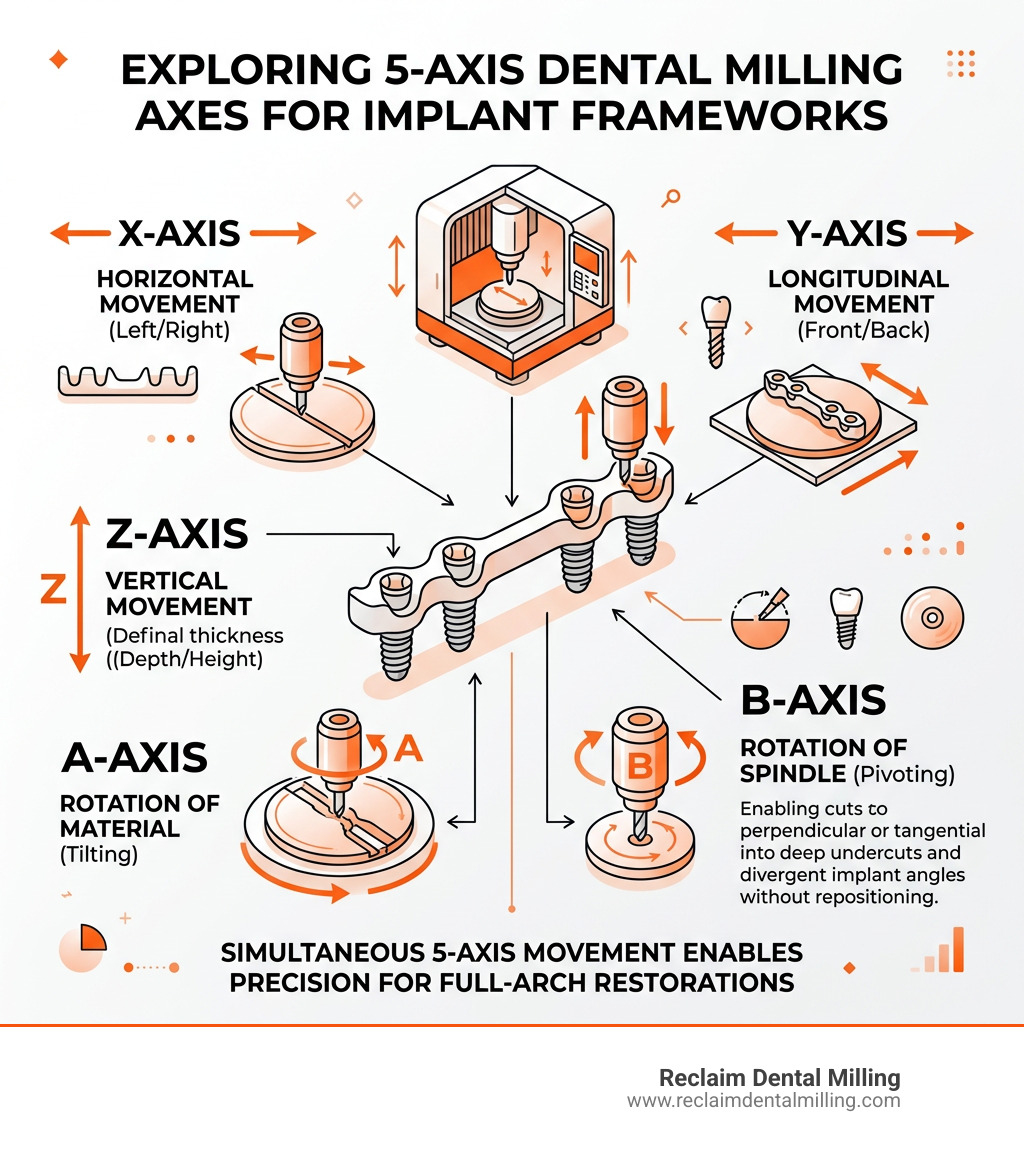
In the early days of digital dentistry, we were limited by the mechanical constraints of 3-axis and 4-axis machines. A 3-axis mill moves in three linear directions (X, Y, and Z). While great for simple crowns, it struggles with the complex “undercuts” and divergent implant angles common in full-arch cases. 4-axis machines added a rotation (the A-axis), which helped, but still required multiple setups and manual intervention to reach deep interproximal areas or complex bar geometries.
The jump to 5-axis technology introduced the B-axis—a second rotational movement. This allows the cutting tool to remain perpendicular or at a specific tangential angle to the surface of the material at all times. For us, this means we can mill deep into the “pockets” of an implant interface or create perfectly parallel attachments without ever removing the disc from the machine.
Research highlights that the rationale for using CAD/CAM technology in implant prosthodontics is centered on eliminating the human error inherent in traditional waxing and casting. By utilizing 5-axis movement, we bypass the distortions of cooling metal and the inconsistencies of hand-finishing, resulting in a framework that is mathematically identical to the digital design.
Precision Engineering in 5 Axis Implant Frameworks
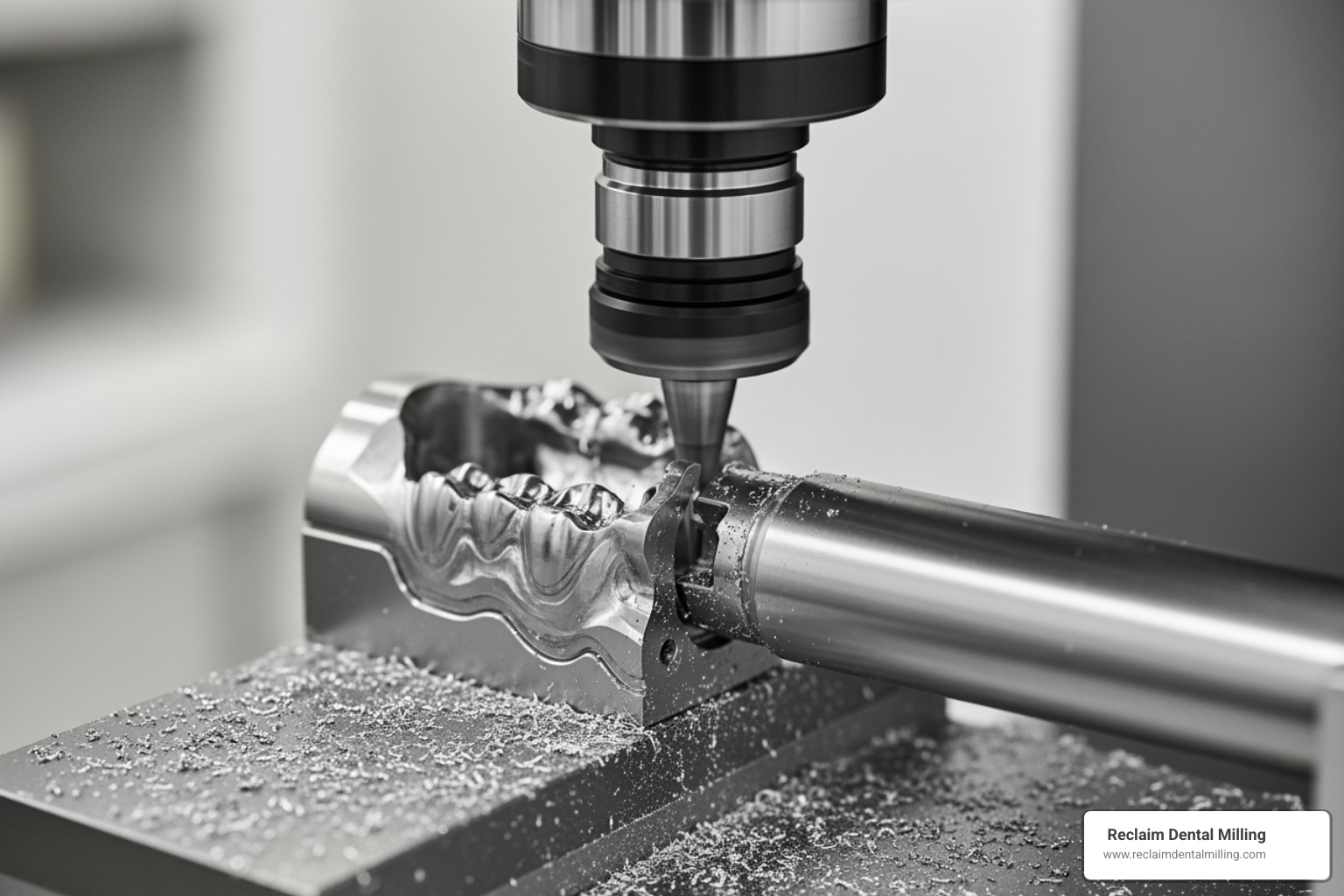
At Reclaim Dental Milling, we don’t just use any equipment; we utilize high-performance milling systems designed for the rigors of metal and zirconia. These machines are beasts. They often feature high-speed spindles, such as the Sycotec DC spindles, which can reach up to 60,000 RPM with 1800 watts of power.
Why does that power matter to you? It means the machine doesn’t “bog down” when cutting through Grade 5 Titanium. High RPMs combined with advanced machine kinematics allow for a smoother surface finish. When the tool moves simultaneously across five axes, it can maintain a constant chip load, reducing vibration. This precision engineering ensures that the internal geometry of the implant connection is crisp, preventing the “micro-wobble” that can lead to screw loosening or biological complications.
Material Versatility for 5 Axis Implant Frameworks
One of the greatest benefits of 5-axis technology is its ability to handle a wide array of industrial-grade materials. We aren’t limited to what a technician can cast in a backyard lab. We work with:
- Titanium Grade 5 (Ti6Al4V): The gold standard for biocompatibility and strength in bars.
- Chrome-Cobalt (Co-Cr): An excellent, rigid alternative for metal-ceramic frameworks.
- Translucent Zirconia: Ideal for highly esthetic, full-contour bridges that require zero metal.
- PEEK and PMMA: Perfect for long-term provisionals and lightweight frameworks.
A systematic review of zirconia frameworks shows that the fit of these materials, when processed via high-end CAD/CAM, is exceptional. By using 5-axis milling, we can ensure that even the most translucent, high-strength zirconia retains its structural integrity through optimized tool paths that prevent micro-fractures during the milling process.
The Digital Workflow: From Scan to Finished Bar
Creating a “better bar” isn’t just about the milling; it’s about a cohesive digital chain. We’ve refined our workflow to ensure that the data you send us from your Phoenix-based practice is translated perfectly into a physical restoration.
- Intraoral Scanning: You capture the patient’s anatomy and implant positions using an intraoral scanner or a desktop scan of a verified model.
- Digital Design (CAD): We import your STL files into advanced design software (like exocad or 3Shape). Here, we design the bar or bridge, ensuring proper support for the final teeth and optimal cleansability.
- CAM Nesting: This is where the 5-axis magic starts. We “nest” the design into a material disc and calculate the tool paths. Our software simulates the 5-axis movement to ensure there are zero collisions between the spindle and the fixture.
- Milling: The machine executes the design. For a titanium bar, this might take several hours of intensive, high-precision cutting.
- Post-Processing: Once milled, the framework is removed. For zirconia, it goes into a high-temperature sintering furnace. For titanium, we perform a series of polishing steps to ensure a high-luster finish on the tissue-facing surfaces.
The Precision Advantage of 5-Axis Milling
When we talk about “passive fit,” we are talking about the holy grail of implant dentistry. If a bar is even a few microns off, it can create tension on the implants. Over time, that tension can lead to bone loss or even implant failure.
Research comparing manufacturing methods shows that 5-axis vector-milled guides and frameworks have significantly lower deviations than 3D-printed alternatives. For example, milled guides show vertical deviations of only 0.41 mm, whereas rapid-prototyped (printed) versions can jump to 1.68 mm.
By choosing subtractive manufacturing (milling) over additive (printing) for your definitive frameworks, you are choosing consistent structural density. A milled block of titanium is a homogeneous, industrial-grade material. It doesn’t have the layers or potential porosities found in printed metals or cast alloys. This leads to a framework that is not only more accurate but also significantly stronger over the long term.
Clinical Benefits of 5-Axis Milled Restorations
From a clinical perspective, the benefits of 5 axis implant frameworks are immediate. When you seat a bar that has been milled with 5-axis precision, you’ll notice:
- Passive Seating: The bar drops into place without the need for heavy hand pressure or “persuasion.”
- Stress Reduction: Because the fit is so accurate, the “Sheffield Test” (one-screw test) is passed every time, ensuring zero tension on the bone-implant interface.
- Screw-Retained Stability: Accurate interfaces mean the screws stay tight. No more “emergency” visits for loose bridges.
- Aesthetics: 5-axis milling allows us to create angled screw channels (up to 30 degrees). This lets us move the screw access hole away from the incisal edge or the facial surface, keeping your restorations looking beautiful.
Frequently Asked Questions about 5 Axis Implant Frameworks
What is the difference between 4-axis and 5-axis milling?
Think of it like a car versus a helicopter. A 4-axis machine can rotate the disc (the A-axis), which helps with some angles. However, a 5-axis machine can also tilt the spindle or the disc holder (the B-axis). This extra degree of freedom is what allows us to mill undercuts and divergent implant angles that a 4-axis machine simply cannot reach without manual intervention.
Can 5-axis machines mill hard metals like Titanium and Co-Cr?
Absolutely. In fact, that’s where they shine. Because 5-axis machines can maintain the optimal angle between the tool and the metal, they reduce tool wear and “chatter.” This results in a cleaner cut and a much more accurate interface than you would get from a less rigid 3-axis machine.
How does 5-axis milling improve the “passive fit” of a bar?
Passive fit is all about accuracy across a long span. In a full-arch case, the machine has to coordinate the position of 4 to 6 different implant interfaces. 5-axis machines use “coordinate synchronization” to ensure that the relationship between every interface is maintained within microns. This level of accuracy is what allows the bar to seat without tension.
Conclusion
At Reclaim Dental Milling, we believe that every patient deserves the precision that only 5-axis technology can provide. We aren’t a massive “mill-for-hire” factory. We are a boutique lab in Phoenix, Arizona, focused on the craftsmanship of All-on-4 and full-arch restorations.
By combining our expertise in 5 axis implant frameworks with a streamlined workflow, we offer a 3-5 day turnaround without the inflated pricing of the big national labs. We help you provide a better product for your patients while keeping your practice profitable.
If you’re ready to see the difference a truly passive fit can make, let’s build your next bar together.