
Spinning Around: How 5 Axis Dental Labs are Changing the Game
Why the 5 Axis Dental Milling Machine Is Transforming Restoration Quality
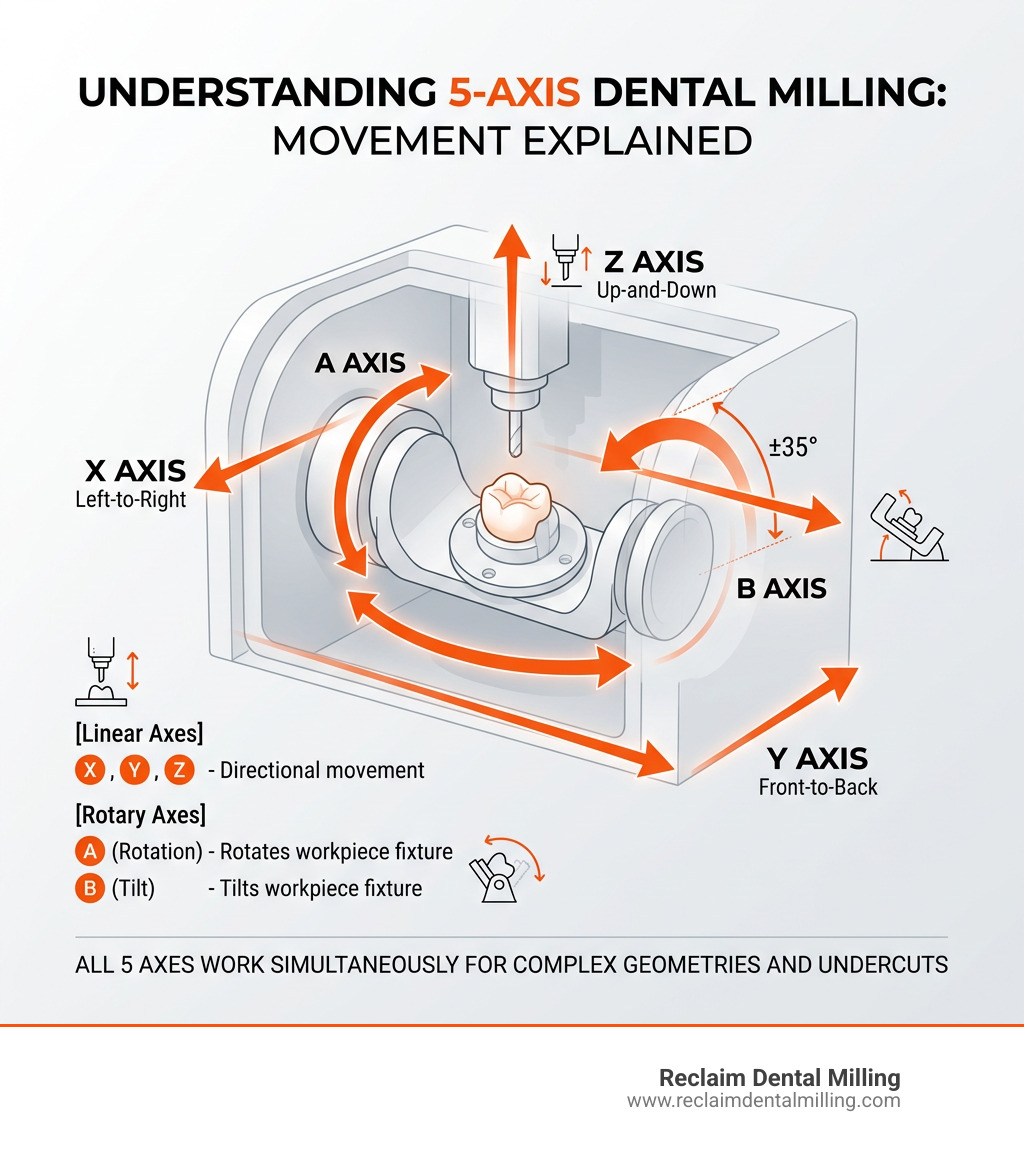
A 5 axis dental milling machine is a precision CNC device that cuts dental restorations by moving along three linear axes (X, Y, Z) and two rotary axes (A and B) — all at the same time.
Here’s what that means for you at a glance:
| Feature | What It Means for Your Cases |
|---|---|
| 5 simultaneous axes | Mills complex shapes and deep undercuts in one setup |
| ±35° B-axis rotation | No repositioning needed for full-arch or implant cases |
| ±0.003 mm accuracy | Passive fit restorations with fewer adjustments chairside |
| Broad material range | Works with zirconia, titanium, PMMA, CoCr, and more |
| Automated production | Consistent quality, faster turnaround — even overnight |
If you’ve ever received a crown from a high-volume milling center that needed excessive grinding to seat, the machine behind it likely wasn’t running true 5-axis simultaneous control. That gap in precision is exactly what this technology closes.
For restorative dentists managing full-arch implant cases, the difference isn’t subtle — it shows up in every try-in, every seating, and every long-term outcome.
I’m Blake Austin, founder of True Impressions Dental Laboratory and Smile Now Dental Implant Center, with over eight years building and equipping high-output dental labs — including selecting and deploying 5 axis dental milling machines for complex implant prosthetic workflows. In the sections ahead, I’ll break down exactly how this technology works, which machines lead the market, and what to look for when precision is non-negotiable.
Understanding the 5 Axis Dental Milling Machine
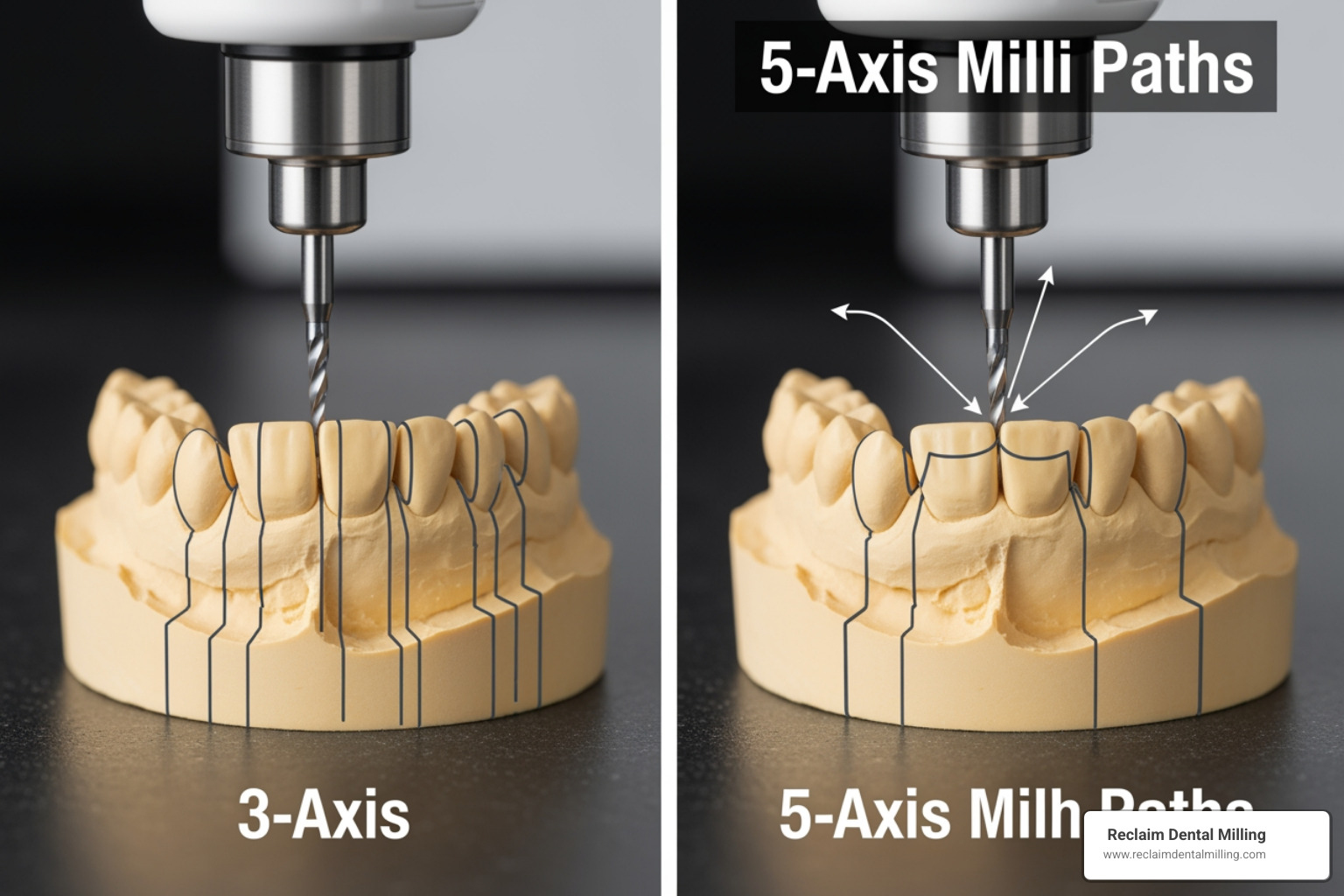
To understand why a 5 axis dental milling machine is the gold standard, we first have to look at how its predecessors operate. In the early days of CAD/CAM dentistry, 3-axis machines were the norm. These move in three linear directions: left to right (X), front to back (Y), and up and down (Z). While great for simple crowns, they struggle with anything “curvy” or deep.
Then came 4-axis machines, which added a rotary axis (A) to flip the material disc. This was a step up, but it still couldn’t reach into the “nooks and crannies” of a complex implant bridge without manual intervention or clever (and often risky) software workarounds.
A true 5-axis machine adds a second rotary axis (B). This allows the milling tool to approach the dental material from virtually any angle simultaneously. Imagine trying to paint a statue while it stays perfectly still (3-axis) versus having someone rotate and tilt the statue in their hands while you paint (5-axis). The latter allows for much finer detail and reaches areas that were previously “blind spots” for the drill.
The Hierarchy of Milling Capabilities
| Machine Type | Axis Movement | Best Suited For | Limitations |
|---|---|---|---|
| 3-Axis | X, Y, Z | Simple inlays, onlays, and single crowns. | Cannot handle undercuts; limited anatomy. |
| 4-Axis | X, Y, Z + A (Rotation) | Standard bridges and frameworks. | Struggles with complex implant angles. |
| 5-Axis | X, Y, Z + A + B (Tilt) | All-on-4, full-arches, and custom abutments. | Higher initial investment, requires expertise. |
Superior Precision and Undercut Capability with a 5 Axis Dental Milling Machine
The real magic happens with the B-axis. In high-end models, this axis can tilt up to ±35 degrees. When we are fabricating a full-arch zirconia restoration or a complex titanium bar, we often encounter “undercuts”—areas where the geometry dips inward.
A 3 or 4-axis machine literally cannot “see” these areas because the tool can’t tilt far enough to reach them. This results in a restoration that doesn’t fit quite right or requires the lab technician to spend hours hand-finishing the piece. With a 5 axis dental milling machine, we achieve a “passive fit.” This means the bridge slides onto the implants or preps with zero tension, which is critical for the long-term health of the patient’s bone and the implant itself.
At Reclaim Dental Milling, we leverage this ±35-degree rotation to ensure that even the most divergent implant angles are accounted for, providing precision restorations that seat perfectly the first time.
Technical Specifications for High-Performance Milling
When we evaluate these machines, we look at several “under the hood” stats that determine how well they’ll perform in a high-stakes environment like Phoenix’s dental market.
- Spindle Speed: Most modern 5-axis mills run between 30,000 and 60,000 RPM, though some high-performance models like the VHF R5 can reach 80,000 RPM. Higher RPM allows for smoother finishes and the ability to use smaller, more delicate burs for fine anatomy.
- Repetition Accuracy: This is the machine’s ability to return to the exact same spot over and over. Top-tier machines boast a repetition accuracy of ±0.003mm (3 microns). To put that in perspective, a human hair is about 50-70 microns thick.
- Spindle Power: Measured in watts, this determines the “muscle” of the machine. An 800-watt spindle can chew through tough Cobalt-Chrome or Titanium without breaking a sweat, whereas a 300-watt spindle is better suited for softer materials like wax or PMMA.
Key Advantages of 5-Axis Technology in Modern Labs
The shift to 5-axis technology isn’t just about being “fancy”; it’s about business survival and clinical excellence. In our lab, the goal is always to minimize the “human touch” required to fix machine errors.
Delivering Unmatched Value Through 5-Axis Efficiency
- Unattended Production: Many of these machines, such as the DGSHAPE DWX-53DC or the PrograMill PM5, feature automatic disc changers. We can load up to 6 or 8 different material discs and let the machine run all night. While we sleep, the machine is busy milling your cases.
- Reduced Manual Finishing: Because the 5-axis path can reach almost every surface, the “as-milled” surface is incredibly smooth. This means our technicians spend less time with a handpiece and more time on the artistry of shading and glazing.
- Material Optimization: 5-axis simultaneous movement allows for “nesting” parts closer together in the material disc. This reduces waste, allowing us to keep our costs down and pass those savings on to our clients.
- Flexible Integration: Modern 5-axis mills are typically “open architecture.” This means they play well with various CAD softwares (like 3Shape or Exocad) and different material brands. We aren’t locked into a single expensive ecosystem.
By utilizing these advanced milling solutions, we provide a 3-5 day turnaround that keeps your practice moving without the “boutique” price tag usually associated with this level of tech.
Material Versatility: From Zirconia to Titanium
A 5 axis dental milling machine is a multi-talented workhorse. Depending on the model, it can process an incredible array of materials:
- Zirconia: The bread and butter of modern dentistry. 5-axis mills handle everything from high-translucency single crowns to high-strength full-arch frameworks.
- Titanium & Cobalt Chrome (CoCr): These “hard” metals require a robust machine with high torque and usually a “wet” milling setup to keep the tools cool.
- PMMA: Used for long-term provisionals and “try-in” bridges. Some spindles are specifically redesigned with 3x the gripping power just to handle the unique challenges of milling PMMA without melting it.
- Glass Ceramics (e.max): These are typically ground using diamond-coated tools in a wet environment.
- PEEK & Wax: High-performance polymers for frameworks and wax for traditional casting or pressing workflows.
Whether you need a titanium bar or a zirconia arch, the 5-axis movement ensures the geometry is captured exactly as it was designed in the digital file.
Choosing the Right Milling Strategy: Wet, Dry, or Hybrid
One of the biggest debates in the lab world is whether to mill “wet” or “dry.”
- Dry Milling: Best for zirconia, wax, and PMMA. It uses air pressure and a vacuum to remove dust. It’s cleaner for the machine’s internal components but creates a lot of airborne “zirconia flour” that requires a high-quality extraction unit.
- Wet Milling: Essential for glass ceramics and metals. A coolant (water or oil-based) is sprayed on the tool and material to prevent overheating.
- Hybrid (The Best of Both Worlds): Machines like the VHF R5 or PrograMill PM5 offer “DirectClean” technology. They can switch from wet to dry milling automatically. They even have built-in ionizers to neutralize the static charge of plastic dust and internal dryers to prep the chamber for the next job.
For many labs, the choice comes down to maintenance. Wet milling zirconia, for example, produces a “sludge” rather than dust. Some experts argue this leads to longer tool life and better margins, while others prefer the simplicity of dry milling. At Reclaim, we choose the strategy that best fits the specific digital workflow for the material at hand.
Advanced Automation for Superior Service Delivery
The latest generation of 5 axis dental milling machines is smarter than ever. Automation isn’t just a luxury; it’s what allows us to offer a 3-5 day turnaround in Phoenix.
Automated Features That Matter:
- Automatic Tool Changers (ATC): Most machines hold between 10 and 16 tools. If a bur breaks or gets dull, the machine detects it, puts the old one away, and grabs a fresh one without human help.
- Automatic Disc Changers (ADC): Imagine a jukebox for dental materials. Machines like the DWX-53DC can swap out discs in just 1 minute and 7 seconds, allowing for 24-hour unattended production.
- RFID Recognition: Some systems use Radio Frequency Identification to “read” the material disc. The machine automatically knows the material type, shade, and translucency, preventing expensive human errors.
- Remote Monitoring: Through cloud-based software (like DGSHAPE CLOUD), we can monitor our mills from a smartphone. If a tool breaks at 2:00 AM, we get a notification immediately.
- Intelligent Tool Control (ITC): This feature tracks how many minutes each bur has been used. It automatically swaps to a “sister tool” before the current one reaches its breaking point, ensuring every crown has a crisp margin.
Frequently Asked Questions about 5-Axis Milling
What is the difference between wet and dry 5-axis milling?
Dry milling uses a vacuum to suck up dust and is primarily for zirconia and resins. Wet milling uses liquid coolant and is necessary for hard metals (titanium) and glass ceramics (lithium disilicate). Hybrid machines can do both but require careful cleaning between cycles to prevent “sludge” from hardening.
How does 5-axis milling enhance the quality of dental restorations?
It eliminates the need for “hand-relieving” undercuts. Because the tool can tilt (the B-axis), it can mill the internal geometry of a crown or bridge exactly as designed. This leads to a “passive fit,” which is essential for implant success and patient comfort.
What maintenance is required for a 5-axis mill?
Daily cleaning is non-negotiable. Zirconia dust is abrasive and can ruin bearings if not vacuumed out. Spindles are “consumable” parts; depending on the model, they may need replacement every 1,000 to 2,000 hours. Some modern machines now feature “user-replaceable spindles” that can be swapped in minutes without a service technician.
Conclusion
The 5 axis dental milling machine has moved from being a high-tech “extra” to an absolute necessity for labs that care about precision. For the dentists we partner with in Phoenix and beyond, this technology translates to restorations that fit better, look more natural, and last longer.
At Reclaim Dental Milling, we combine this industrial-grade technology with boutique craftsmanship. We specialize in the “hard stuff”—All-on-4 restorations and full-arch zirconia or titanium implants. By focusing on 5-axis simultaneous milling, we ensure that every case has a passive fit, all while maintaining a 3-5 day turnaround.
If you are looking for a partner that values precision as much as you do, we invite you to view our full range of professional milling services. Let’s change the game together, one rotation at a time.